
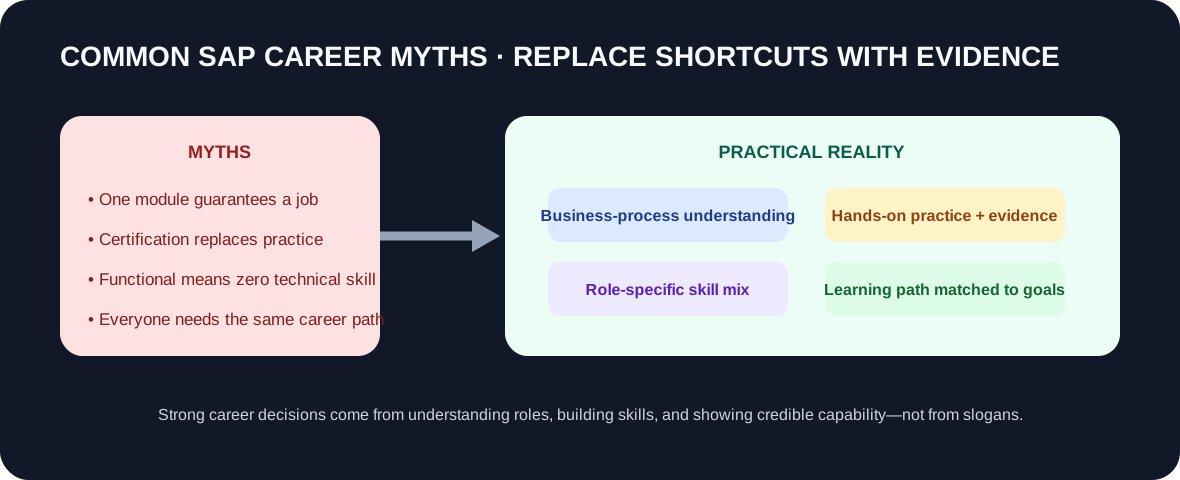
The most common SAP career myths exaggerate certainty. No single module, certificate, transaction list, degree, or short course guarantees employment. Certification can validate knowledge, but practical understanding still matters. Functional roles still need technical literacy. Technical roles still need business context. The right path depends on the role you want, the background you bring, and the evidence of capability you can build.
Myth 1: “Choose the hottest module and you will get a job”
Module popularity matters less than fit between your background, your target role, market demand, and your ability to explain the underlying business process. A finance professional may build a stronger starting story in SAP FI than in a module chosen only because someone called it “trending.” A developer may be better served by a technical path that uses existing coding strengths.
Use module choice as a career-design decision, not a lottery ticket. The first question is not “Which module pays the most?” but “Which role can I credibly grow into?”
Myth 2: “Certification is enough”
SAP describes certification as a way to validate SAP expertise and demonstrate knowledge and skills. That is useful, but validation is not the same as work experience or practical problem-solving. SAP Learning also distinguishes learning journeys, hands-on practice systems, and certification—three different parts of capability development.
A stronger plan combines learning and certification appropriately with legitimate hands-on practice. A certificate can strengthen a profile; it cannot explain a business process for you in an interview.
Myth 3: “Functional consultants do not need technical knowledge”
Functional consultants do not need to become full-time developers, but they do need technical literacy. Interfaces, data migration, authorization, workflow, reports, extensions, APIs, error analysis, and testing all cross the functional-technical boundary. The depth varies by role and project, but “functional” does not mean “technical concepts are irrelevant.”
Myth 4: “You need to learn many modules before applying”
Early learners often confuse breadth with credibility. A person who can explain one end-to-end process, its master data, controls, integration points, and common exceptions is usually more convincing than someone who lists several modules but cannot connect them to business outcomes. A second module can help when it is adjacent and purposeful; see when learning two SAP modules makes sense.
Myth 5: “Transaction codes are the skill”
Transaction codes and app navigation are useful operational knowledge, but they are not the underlying skill. Systems change, interfaces evolve, and roles differ. The durable capability is understanding why the process exists, what data drives it, which controls matter, what the expected outcome is, and how to diagnose an exception.
Myth 6: “A non-IT background is automatically a disadvantage”
Many SAP roles sit directly inside finance, procurement, sales, manufacturing, maintenance, quality, HR, and other business functions. Domain knowledge can be valuable when it is translated into process understanding. The gap is usually not “wrong degree”; it is missing SAP context, implementation thinking, or technical literacy required for the chosen role.
Myth 7: “A course can make you job-ready on a fixed date”
Training timelines are useful for planning, but job readiness is a capability question. Can you explain the process? Can you reason through master data and controls? Can you describe integration? Can you test a scenario and explain an exception? Can you communicate clearly? Use job-readiness milestones instead of treating a calendar promise as proof.
What to believe instead
- Choose a role before chasing a label: understand what the work actually involves.
- Build process depth: learn why the system behavior matters to the business.
- Practice honestly: use learning systems, exercises, and self-created scenarios without inventing client experience.
- Use certification appropriately: as one signal of validated knowledge, not a substitute for capability.
- Show evidence: explain scenarios, process maps, test thinking, and what you learned from mistakes.
- Expect continuous learning: SAP products, delivery methods, and job expectations continue to evolve.
Consultant thinking: replace career certainty with decision quality
No responsible career plan can guarantee a hiring outcome. What you can control is the quality of your preparation: the role you target, the depth of your business-process understanding, the legitimacy of your hands-on practice, and how clearly you communicate what you know and what you still need to learn.
Key takeaway
Most SAP career myths are attractive because they make a complex career decision sound simple. A better path is evidence-based: choose deliberately, learn deeply, practice credibly, validate where useful, and measure readiness by capability rather than slogans.