
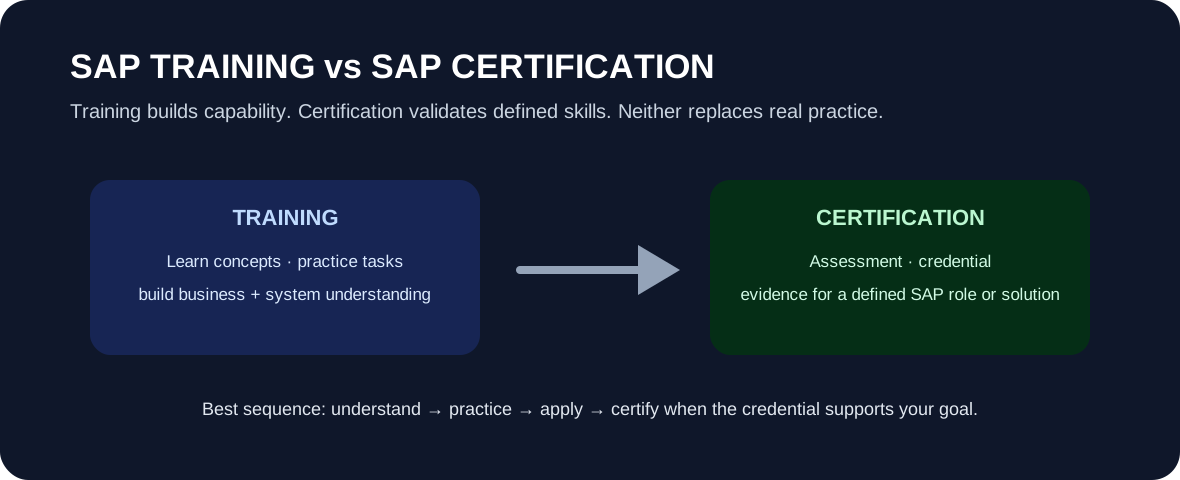
SAP training helps you learn concepts, processes and system skills through structured content, practice and feedback. SAP certification evaluates whether you can demonstrate the knowledge or applied skills required for a particular certification. If you are choosing what to prioritize, build understanding and practice first; pursue certification when that credential supports your target role, employer requirements or personal learning goal.
Training and certification solve different problems
The simplest distinction is purpose. Training answers: How do I build the capability? Certification answers: Can I demonstrate the capability defined by this credential?
SAP Learning Journeys are designed to help learners build skills at their own pace and prepare for certification. SAP also offers practice systems where learners can work in live SAP environments. Certification sits later in that learning chain as formal validation, not as a replacement for the learning itself.
What SAP training can include
Training is broader than attending a classroom. It can include self-paced courses, Learning Journeys, live sessions, guided exercises, practice systems, peer discussion and independent review. SAP describes its Learning Journeys as structured learning content that includes lessons and hands-on practice, and its practice systems as live environments where learners can build experience.
For a beginner, effective training should connect three layers: business process understanding, SAP concepts and hands-on system behaviour. Memorizing navigation without understanding why a process works rarely creates durable consultant capability.
What certification adds
SAP Certification provides a formal credential for a defined solution or role. SAP’s current program emphasizes practical and performance-based assessment, with system-based and scenario-based approaches becoming part of the certification model. Passing can result in a digital badge that can be verified and shared.
That credential can be useful because it gives employers or clients a standardized signal that you met SAP’s certification requirements. But the signal has boundaries: it does not tell an employer how well you run workshops, diagnose ambiguous business problems, communicate with stakeholders or perform in a real project team.
When certification can be worth prioritizing
- A target role or employer explicitly asks for the certification.
- You already understand the module and want an external milestone to validate your learning.
- Your organization or partner program uses certification as part of role readiness.
- You want a structured deadline that forces disciplined preparation.
- The certification aligns closely with the work you actually want to do.
Do not choose a certification merely because its title sounds impressive. Start with the role and module direction. If you are still uncertain, choose your first SAP module before optimizing for a credential.
When training should come first
If you cannot yet explain the business process in plain language, trace an end-to-end scenario or connect common master data and transactions, certification preparation may become memorization rather than capability building. Use training and practice to close those gaps first.
The same principle applies to career switching. Becoming job-ready in SAP involves more than completing a course or passing an exam. Employers can test business understanding, problem solving, communication and practical reasoning that sit outside the certification itself.
A practical sequence for beginners
- Choose a sensible SAP role or module direction.
- Learn the underlying business process before memorizing screens.
- Use structured training to understand the solution.
- Practise in a system and explain what happens before and after each step.
- Build small scenario-based examples you can discuss confidently.
- Review the certification blueprint and current exam approach.
- Take certification when it adds value to your target path.
If you are considering more than one area, understand when learning two SAP modules makes sense rather than collecting unrelated certifications.
Key takeaway
Treat training as capability building and certification as structured validation. A strong SAP career usually depends on what you understand, can practise and can explain; certification can strengthen that profile, but it works best as evidence of learning rather than a substitute for it.