
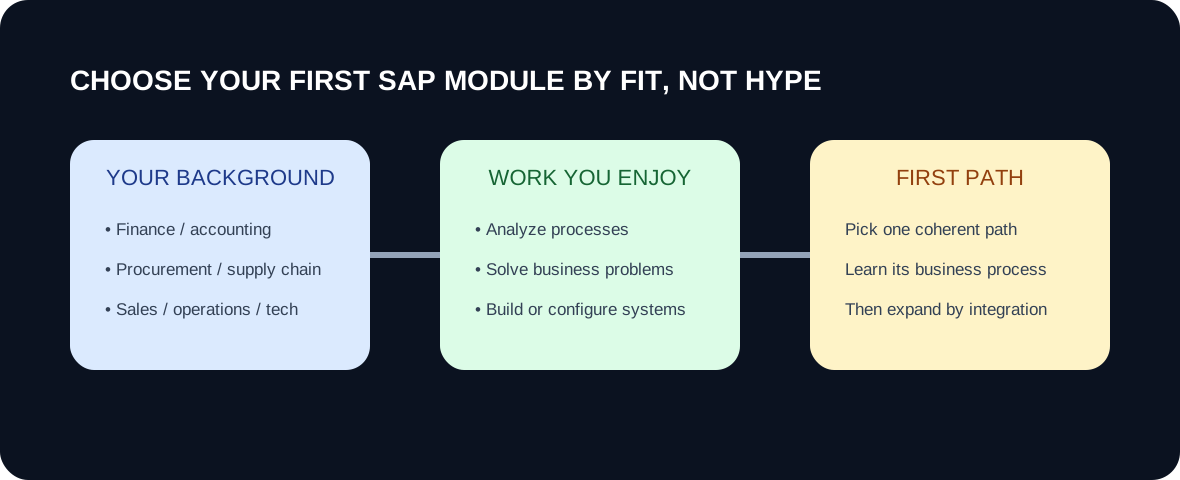
Choose your first SAP module by matching four things: the business processes you already understand, the work you enjoy, the roles you want to target, and the learning resources or practice opportunities you can realistically use. Start with one coherent path and build enough depth to explain its business process before adding adjacent modules.
Start with your background
An accountant may find finance concepts more intuitive; a buyer or supply-chain professional may recognize procurement and inventory processes; a sales-operations professional may understand order-to-cash; a production or industrial engineer may connect naturally with planning and manufacturing; and a software developer may prefer technical paths such as ABAP, BTP or integration.
That is not a rigid rule. Background gives you a starting advantage, not a lifetime restriction. The goal is to reduce the number of new concepts you must learn at once.
Use process fit before market noise
Ask what business process sits behind the module. Can you see yourself discussing customer orders, purchasing, accounting, production, maintenance, analytics, development or integration every day? A module is easier to learn when its problems feel meaningful to you.
SAP Learning organizes content into role- and topic-oriented Learning Journeys and describes them as structured paths for building relevant skills. That reinforces a practical principle: choose a path around a skill goal, not a collection of disconnected course names.
Check role fit and learning access
Look at the role you want, not just the module label. What would an entry-level person in that path be expected to explain or do? Then check whether you have access to good learning content, practice systems, mentors or realistic project-style exercises. A theoretically perfect module is less useful if you cannot practice it meaningfully.
Avoid two common mistakes
Do not choose purely because someone claims one module has the “highest salary,” and do not assume a technical module is automatically better than a functional one. Compensation and opportunity depend on role, skill depth, experience, geography, company and market conditions. Your first goal is a credible foundation.
What to do after choosing
Spend enough time on the business process and core concepts that you can explain them without relying on transaction-code memorization. Then build practical examples and interview-ready explanations. See how much business knowledge an SAP consultant needs and the N2i SAP path overview.