
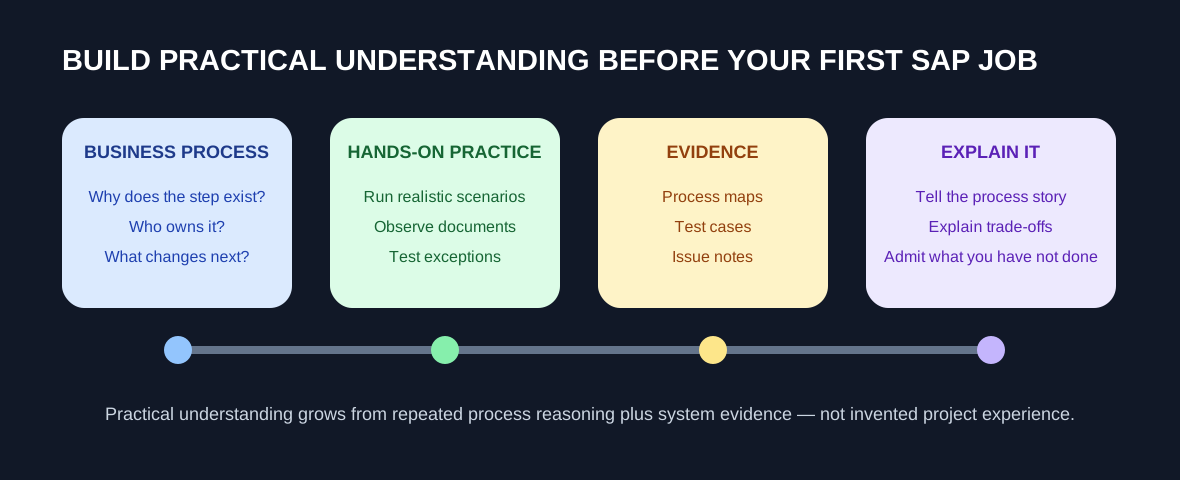
Build practical SAP understanding without work experience by learning one end-to-end business process, practicing realistic scenarios in a legitimate SAP learning environment when available, documenting the business and system consequences, testing exceptions, and explaining your reasoning in your own words. Keep the distinction clear: training and practice can demonstrate capability, but they are not client implementation experience.
Start with a business process, not a transaction list
A beginner who memorizes screens can appear comfortable until one field changes or an exception occurs. A learner who understands the process can reason through unfamiliar situations. Choose one process relevant to your path—such as Procure-to-Pay for MM, Order-to-Cash for SD, Record-to-Report for FI, or Plan-to-Produce for PP—and map the business actors, documents, approvals, master data, accounting or inventory consequences, and common exceptions.
This also makes choosing a first SAP module more concrete: the question becomes which business process you want to understand deeply, not which acronym appears most often in job advertisements.
Use legitimate hands-on environments when available
SAP Learning explicitly offers hands-on practice and Learning Journeys, and SAP Learning Hub practice systems provide preconfigured live SAP environments for exercises and experimentation. These resources can help bridge the gap between reading and doing. Access varies by offering and subscription, so use the resources legitimately available to you rather than assuming every learner has the same system access.
SAP's certification program is also moving toward practical, performance-based assessments for parts of the portfolio. That reinforces an important learning principle: applied skill matters. But training and certification still serve different purposes, and neither should be presented as employment experience.
Build evidence that is honest and useful
Your portfolio does not need confidential client material. Create original process maps, scenario notes, test cases, master-data decision sheets, integration explanations, and issue analyses using fictional data. Label them clearly as learning or practice artifacts. The objective is to show how you think.
A repeatable practice loop
- Predict: before executing a step, state what you expect to happen.
- Execute: perform the scenario in an authorized learning system when available.
- Observe: inspect documents, statuses, accounting, stock, or other downstream effects.
- Explain: write the business reason and system consequence in plain language.
- Break it safely: try a controlled exception in practice and diagnose why it behaves differently.
- Review: compare your explanation with authoritative SAP learning or help material.
What not to claim
Do not convert a classroom exercise into “one implementation.” Do not invent customer names, go-lives, configuration ownership, or production incidents. Say “I practiced,” “I built a learning scenario,” or “I can explain” when that is what happened. This makes interviews easier because your story remains consistent under follow-up questions.
Consultant thinking: practice decisions, not clicks
Consultants are valuable because they connect business requirements with system behavior, controls, trade-offs, and consequences. Even before your first job, you can practice that mental model. For every scenario, ask what decision the business is making, what data enables it, what could go wrong, who owns the exception, and what evidence proves the process worked.
Key takeaway
You do not need fake experience to become more practical. Build depth in one process, use legitimate hands-on practice, create honest evidence, test exceptions, and learn to explain consequences. That is a credible foundation for your first real SAP role.