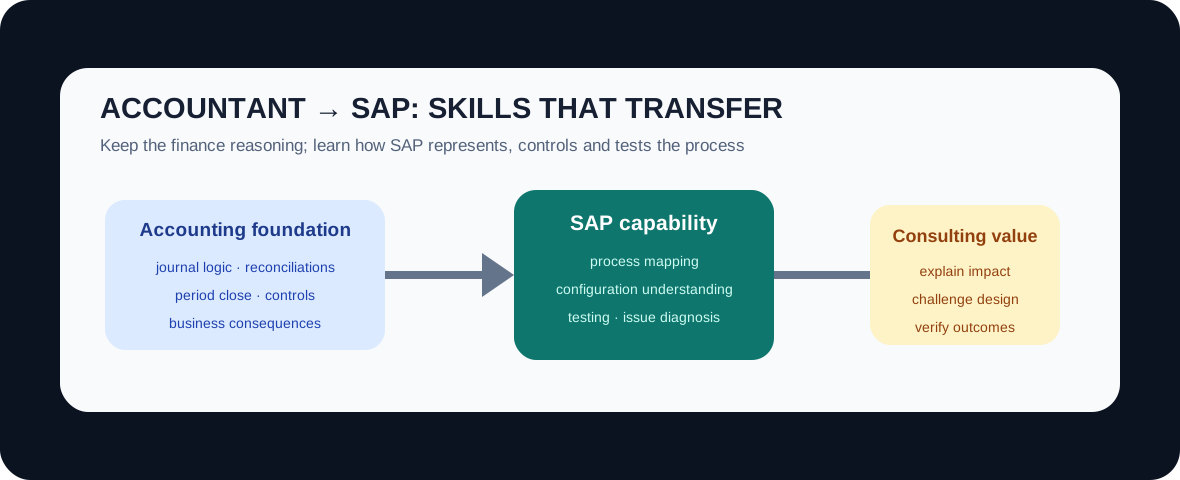
An accountant moving into SAP can transfer substantial business knowledge: debit-credit logic, journal entries, general-ledger structure, accounts payable and receivable, reconciliations, period-end close, fixed assets, tax awareness, internal controls, audit evidence and financial reporting. Process discipline, exception analysis and stakeholder communication also transfer well. What does not transfer automatically is SAP-specific configuration, master-data design, integration knowledge, testing discipline, implementation methods or hands-on system experience. The career switch is strongest when you use accounting knowledge as the business foundation and deliberately add SAP capability on top.
Your advantage is business meaning
A learner without finance experience may first have to understand why a supplier invoice creates a liability, why a reconciliation account exists, why open items are cleared, or why period-end valuation is necessary. An accountant often already understands the business purpose behind these controls.
That matters because good functional SAP work is not about memorizing transaction codes. It is about translating business requirements into a controlled system process, testing whether the result is correct, and explaining consequences to users and technical colleagues.
Transferable skill 1: accounting logic
Journal-entry reasoning transfers directly. If you can explain what should be debited and credited, why a balance belongs on the balance sheet or income statement, and how a transaction affects financial statements, you already have the conceptual base for many FI discussions.
This helps when learning topics such as G/L account master data, open-item management and financial statement versions. The SAP layer adds system rules and structure to accounting ideas you already know.
Transferable skill 2: close and reconciliation discipline
Accountants understand that a balance is not trustworthy merely because the system produced it. Bank accounts need reconciliation, subledgers need review, GR/IR and intercompany differences need investigation, foreign-currency positions may need valuation, and cut-off matters.
This mindset is valuable in SAP because implementation and support work often involves tracing why a financial result differs from expectation. The habit of moving from balance → transaction → source document → business cause is closely related to functional troubleshooting.
Transferable skill 3: controls and audit thinking
Accounting roles build sensitivity to authorization, segregation of duties, approval, evidence, period control and master-data governance. Those concerns appear throughout SAP design. A requirement is not complete until the project understands who may perform the action, what should be prevented, what must be approved and what evidence must remain.
An accountant who can explain the control objective—not merely say “the auditor requires it”—can contribute meaningfully to requirement and design discussions.
Transferable skill 4: process and exception knowledge
Real accounting work contains exceptions: blocked invoices, unmatched receipts, unidentified customer payments, disputed deductions, unusual journal entries and late close tasks. This experience helps you recognize the difference between a clean textbook process and the messy operational reality that an ERP system must handle.
That is particularly useful for functional consulting because configuration and testing must account for normal flows and exceptions. Your examples can become better business scenarios, provided you learn how SAP represents them.
Skills that transfer only partly
Some experience needs reframing. Advanced spreadsheet work is useful for analysis, but an ERP consultant should not assume a spreadsheet workaround is the target system design. Company-specific closing routines may teach strong process discipline, but SAP projects require you to separate universal accounting needs from one employer's historical procedure.
Likewise, experience as an SAP end user can help, but using transactions does not automatically teach configuration, integration, data design or implementation decision-making.
What you still need to learn
- SAP organizational structure: company codes, controlling areas, plants, sales organizations and how they relate.
- Master data: G/L accounts, business partners, materials, cost objects and the governance around them.
- Configuration concepts: how business rules are represented and controlled in SAP.
- Integration: how procurement, sales and controlling events affect Finance; see FI integration with CO, MM and SD.
- Testing: how to design scenarios, expected results, negative cases and evidence.
- Project work: requirements, fit-to-standard, design decisions, defects, cutover and support.
How to present transferable skills credibly
Do not claim SAP implementation experience you do not have. Instead, describe the business processes you genuinely know and connect them to what you are learning. For example: “I have performed month-end account reconciliations and investigated unmatched balances; I am now learning how SAP FI represents open items, clearing and period-end controls.”
This is more credible than converting every accounting task into an SAP buzzword. It also makes your learning plan clearer. The companion article on best-fit SAP paths for accountants can help identify where that finance foundation is most relevant.
Key takeaway
Accountants bring valuable transferable skills into SAP: accounting logic, close discipline, reconciliation, controls, exception analysis and business communication. Those skills reduce the distance to functional understanding, but they do not replace SAP-specific system, integration, testing and implementation capability. A strong career switch combines both honestly.