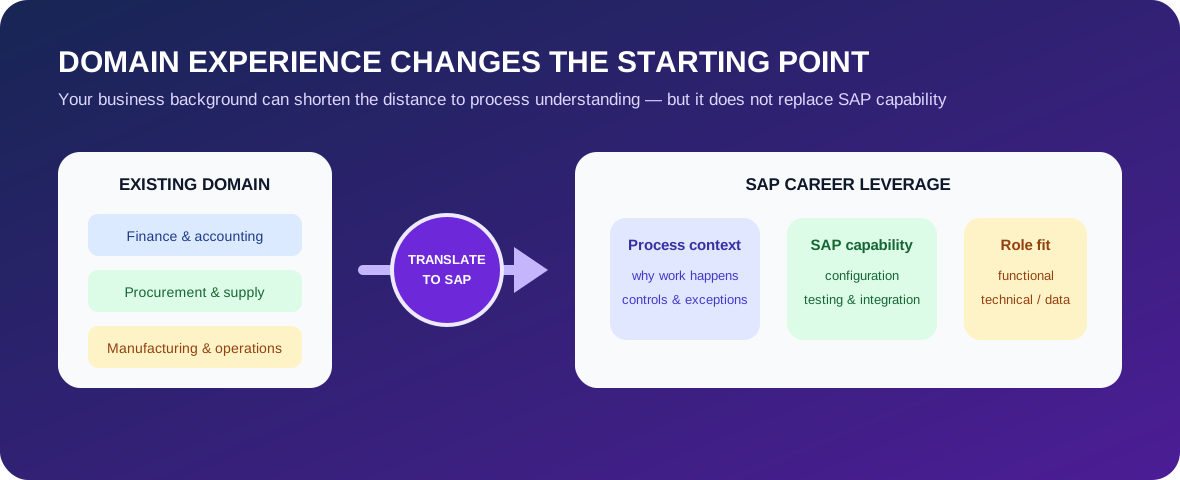
Domain experience can make an SAP career transition more focused because it gives you existing knowledge of business processes, terminology, controls, exceptions and stakeholder needs. A finance professional may have a natural route toward SAP finance work; a buyer toward procurement; a planner toward manufacturing or supply-chain areas. But domain experience is an input, not an automatic qualification: you still need SAP process, data, integration, testing and delivery capability.
Domain experience changes what you already know
A career switcher rarely starts from zero. Someone who has processed supplier invoices may already understand payment terms, approvals, tax checks and exception handling. A production planner may understand material shortages, capacity constraints and schedule changes. A sales-operations professional may understand quotations, orders, pricing, delivery and billing dependencies.
That context helps because SAP systems model real business processes. SAP Learning's role- and process-oriented learning content repeatedly connects system activities with business outcomes, organizational responsibilities and end-to-end processes. The learner who already understands the business side can spend more effort learning how that process is represented in SAP.
It can influence module or role fit
Domain alignment can make an initial learning path more intuitive. Accounting and finance experience may align with FI or CO concepts. Procurement and inventory experience may align with MM and adjacent supply-chain areas. Sales and order-management experience can help with SD. Production, planning and shop-floor experience can support PP, QM or EAM learning depending on the work actually performed.
But alignment is not a rule. Interests, analytical strengths, technical aptitude and target job market also matter. Choosing a first SAP module should consider both what you already know and the kind of work you want to do next.
Domain experience helps most when you can explain cause and effect
Saying “I worked in accounts payable for five years” is less useful than explaining what happened when invoices did not match purchase orders, how payment blocks were handled, why supplier master data mattered, or how month-end cutoffs affected liabilities. That cause-and-effect knowledge transfers directly into better SAP process reasoning.
This is also why business knowledge for SAP consultants matters. A consultant needs enough process understanding to ask better questions, interpret exceptions and understand the consequence of a design choice.
Where domain experience can become a trap
- Assuming every company works the same way: your previous employer's process is one implementation, not a universal standard.
- Confusing business expertise with SAP expertise: knowing procurement does not automatically mean knowing SAP MM configuration, data or integration.
- Rejecting standard processes too early: “We always did it this way” is not evidence that a new organization needs the same design.
- Overselling experience: domain work should be presented honestly rather than described as SAP project experience if it was not.
- Ignoring adjacent processes: strong domain knowledge becomes more valuable when you learn the upstream and downstream impacts.
How to use domain experience in learning
Build examples from situations you genuinely know. Map the actors, documents, approvals, master data, exceptions and accounting or operational consequences. Then learn how SAP supports that process. This creates a stronger mental model than memorizing isolated screens.
If you do not yet have SAP work experience, the same method supports practical SAP understanding without work experience: use legitimate practice to connect system behavior with realistic business scenarios, without claiming client experience you do not have.
Consultant thinking: treat domain knowledge as a hypothesis advantage
Experience helps you form better initial hypotheses: where a control may fail, what a user means by an exception, which stakeholder owns a decision. But consultants still validate those hypotheses with the current business. Good domain experts are valuable because they ask sharper questions, not because they assume they already know every answer.
Key takeaway
Domain experience can accelerate an SAP career by giving you business context, vocabulary and realistic process judgment. Use it to choose a sensible starting direction and build stronger examples, while deliberately adding the SAP-specific skills that your previous role did not require.