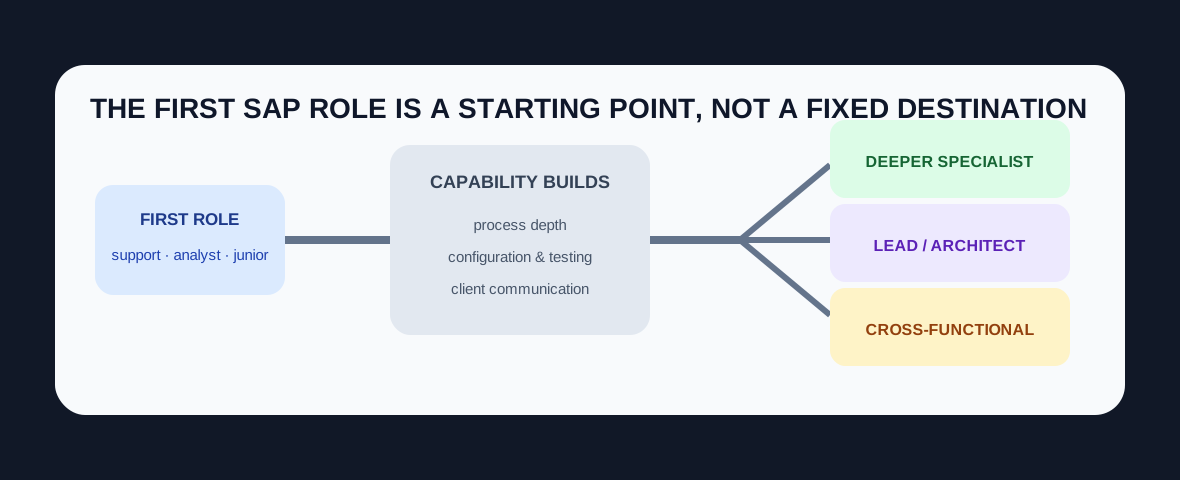
After a first SAP role, career growth can move in several directions: deeper functional or technical specialization, broader end-to-end process ownership, cross-module or integration responsibility, delivery leadership, solution architecture, product ownership, or people management. The strongest progression usually comes from becoming more reliable at solving larger business problems rather than chasing titles alone.
The first stage is dependable execution
Early in an SAP career, the priority is to become trusted with well-bounded work. That may mean configuration support, testing, incident analysis, master-data tasks, documentation, reports, development objects, interfaces or workshop follow-up depending on the role.
The important shift is from needing detailed supervision to being able to understand an issue, gather evidence, complete the assigned work, communicate risk and ask for help at the right time. This is the foundation for every later path.
Growth can deepen or broaden
One path is deeper specialization: becoming the person others trust for a difficult area such as tax, product costing, warehouse design, integrations, authorizations, performance or a specific industry process. Another path is broader process ownership: understanding how one function connects with adjacent teams, data and systems.
Neither path is automatically better. A specialist creates value through depth; a process lead or architect creates value through connected judgment. Many experienced professionals combine both by building a strong home area first and adding adjacent knowledge over time.
What tends to unlock the next level
- Business-process depth: understanding why the process exists, not only which screen or transaction is used.
- Integration thinking: anticipating downstream effects across finance, logistics, data, security and reporting.
- Delivery discipline: estimating, documenting, testing and closing work reliably.
- Communication: explaining trade-offs differently to users, developers, managers and architects.
- Judgment: knowing when standard design is enough, when escalation is needed and when a change creates avoidable complexity.
Titles do not progress at the same speed everywhere
Consulting firms, product teams and end-user organizations use titles differently. One company may call a role “senior consultant” while another uses “lead” for similar responsibilities. Compare scope, decision authority and problem complexity instead of assuming a title has a universal meaning.
This is why entry-level role expectations and job-readiness milestones are more useful than rigid career timelines. The same principle continues after the first job.
Consultant thinking: build a capability portfolio
Track the situations you can now handle independently: a workshop you facilitated, a defect you diagnosed, an interface you helped validate, a closing issue you resolved, a design decision you documented, or a go-live risk you communicated. These are stronger signals of growth than simply counting years.
Key takeaway
Career growth after the first SAP role is a shift from task execution toward larger ownership, deeper expertise and better judgment. Choose a direction that fits your strengths, but keep building process, integration and communication capability because those skills travel across roles.