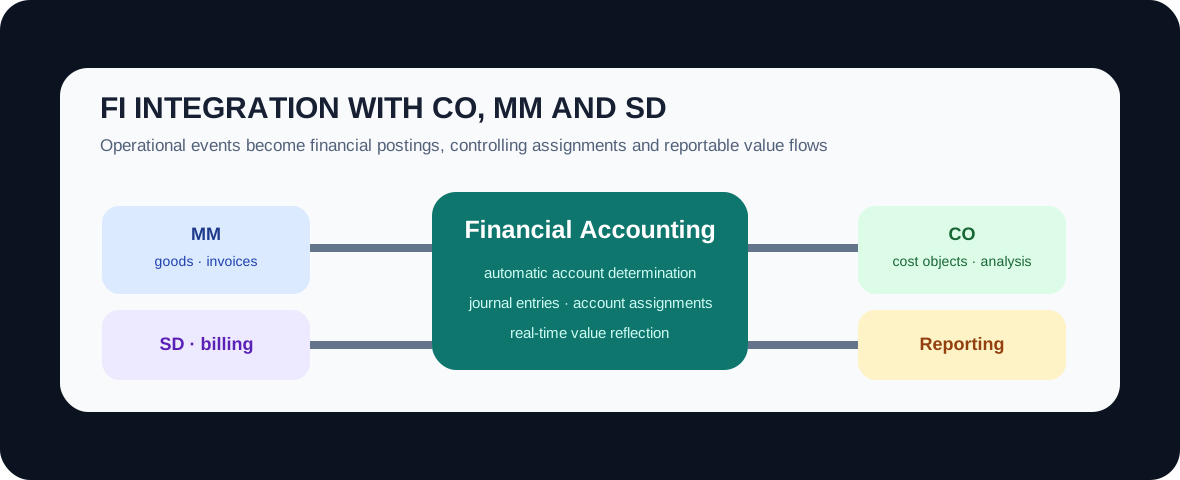
SAP FI integrates with MM, SD and CO because operational transactions have financial consequences. Procurement and inventory events in MM can create accounting documents for stock, consumption, GR/IR and supplier liabilities. Billing in SD can create receivables, revenue and tax postings in FI. CO receives and analyzes cost and revenue assignments such as cost centers, orders, projects or profitability dimensions. In SAP S/4HANA, the Universal Journal further integrates financial and management-accounting information at line-item level.
Integration starts with a business event
Think of integration as a chain of consequences rather than a set of module interfaces. When a warehouse receives purchased material, the business has gained an asset or incurred consumption and may also have a receipt/invoice timing difference. When Sales bills a customer, the business creates a receivable and recognizes revenue according to the configured process. When an expense is posted, management may need to know which cost center, order or project is responsible.
The system connects these views through master data, account determination, organizational assignments and document relationships. That is why an FI consultant needs to understand the upstream process: a financial posting can be technically correct only if the logistics event and its account assignments represent the business correctly.
MM to FI: procurement and inventory become accounting
In procurement, the purchase order itself normally represents a commercial commitment rather than an FI posting. The accounting impact typically appears when goods or services are received and when the supplier invoice is posted. For stock material, a goods receipt can debit inventory and credit a GR/IR clearing account. The invoice then creates the supplier liability and clears or adjusts GR/IR according to the transaction.
For consumption procurement, account assignments such as a cost center, internal order, asset or project can determine where the expense belongs. Automatic account determination uses factors such as valuation class and transaction/event keys to derive G/L accounts. This is why clearing and reconciliation concepts and logistics master data both matter to a clean procure-to-pay close.
SD to FI: billing becomes receivable and revenue
Sales orders and deliveries build the commercial and fulfillment chain, but billing is the key point at which SD commonly transfers accounting-relevant information to FI. The resulting accounting document can include the customer receivable, revenue, tax and other configured accounts.
Revenue account determination uses sales and master-data attributes to select the appropriate G/L accounts. The customer is linked to FI through its reconciliation account, so subledger activity is reflected in the general ledger without direct manual posting to that reconciliation account. Credit management, payment and clearing processes then continue the order-to-cash financial lifecycle.
CO and FI: the same posting answers a management question
Management accounting asks where costs and revenues belong internally. A posting may therefore carry cost center, order, project, profit center or profitability information in addition to the external-accounting dimensions required by FI. In SAP S/4HANA, the Universal Journal provides a shared line-item foundation for financial and management accounting.
This does not mean every FI posting automatically has every CO dimension. Account type, master data, derivation and process design determine which assignments are relevant and mandatory. Good integration design makes those requirements explicit at the business event where the information is known.
Where integration problems usually surface
- Wrong G/L account: investigate account determination and the master-data attributes that drive it.
- Unexpected cost object: trace account assignment, defaulting and derivation rather than changing the FI document in isolation.
- GR/IR imbalance: compare goods receipts, invoice receipts, quantities, values and timing.
- Billing does not post: inspect billing status, account determination, customer accounting data and error logs.
- Profit-center reporting is incomplete: examine derivation and, where relevant, document splitting.
Consultant thinking: trace forward and backward
When an accounting result looks wrong, trace backward to the operational document and the master data that existed when the event occurred. When designing a process, trace forward from the operational event to every financial, management-accounting, tax, reporting and reconciliation consequence.
This two-way habit prevents “module tunnel vision.” SAP integration is strongest when the project treats procurement, sales, accounting and controlling as one business process with different responsibilities rather than separate systems exchanging mysterious postings.
Key takeaway
FI integration with MM, SD and CO is the accounting expression of connected business processes. MM supplies procurement and inventory events, SD supplies sales and billing events, FI records external financial consequences, and CO provides internal responsibility and performance dimensions. Master data, account determination and process timing determine whether those consequences are accurate and reconcilable.