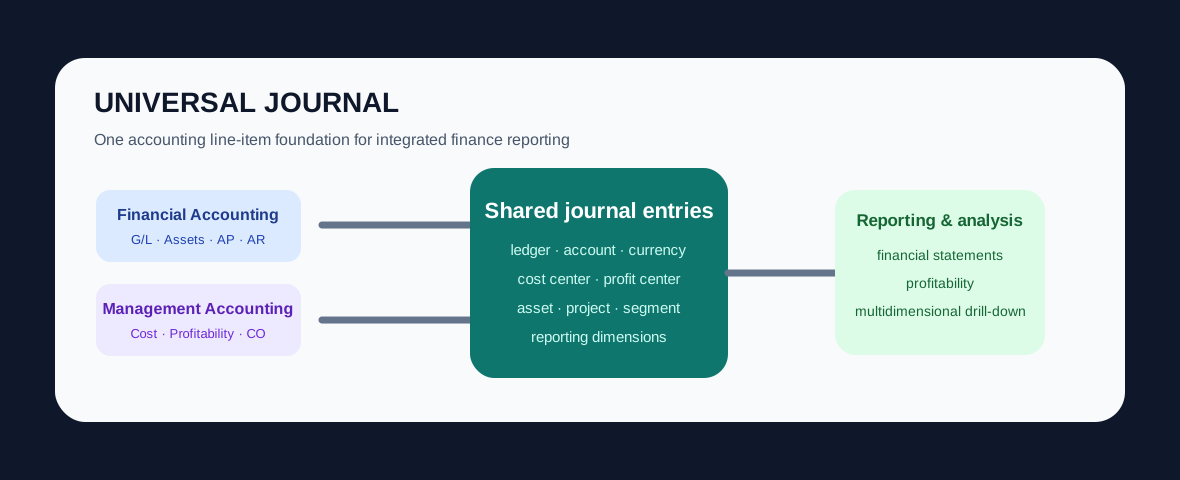
In SAP S/4HANA, the Universal Journal is the central accounting line-item concept that records financial and management-accounting information together. SAP describes it as the basis of an integrated accounting system in which financial accounting and management accounting data are recorded in a single chart of accounts. The practical result is that many reporting dimensions, currencies and account assignments are available on the same journal-entry foundation rather than being reconciled across separate accounting representations.
What problem the Universal Journal solves
Traditional ERP finance designs often separated parts of financial accounting, controlling, asset accounting, profitability analysis and other subareas into different data structures. That could create duplicated storage, separate totals, and reconciliation work between views of the same business event.
SAP S/4HANA simplifies that architecture. SAP Help explains that financial and management accounting journal entries use the same underlying line items, while SAP Learning describes the Universal Journal as a common line-item persistence used across General Ledger, Profit Center Accounting, Fixed Asset Accounting, Controlling, Material Ledger and Margin Analysis. The aim is not that every process becomes identical; it is that accounting views share a more unified data foundation.
It is more than “FI and CO in one table”
A simple explanation is that the Universal Journal brings FI and CO closer together, but the business value is broader. A journal entry can contain the account and ledger information needed for external reporting while also carrying internal dimensions such as cost center, profit center, project or other coding-block attributes where relevant.
This makes the accounting line item richer. A reporting user can move from a financial statement amount into operational dimensions without first reconciling separate totals. It also supports capabilities such as multiple currencies and parallel accounting consistently across the accounting model.
Why the chart of accounts matters even more
The Universal Journal reinforces the importance of a well-designed chart of accounts because primary and secondary cost information is represented within the integrated accounting framework. SAP Help notes that the chart of accounts includes balance-sheet and income-statement accounts as well as accounts for secondary costs.
That is one reason S/4HANA finance design discussions cannot treat G/L account architecture as a narrow FI configuration topic. Account design, controlling logic and reporting requirements need to be considered together.
How it changes reconciliation thinking
The phrase “single source of truth” is often used loosely. In this context, the important point is architectural: where the same accounting event and dimensions are stored on a common journal line-item foundation, many reconciliations that previously existed only because data was duplicated across separate accounting structures are reduced by design.
That does not mean Finance can stop reconciling business processes. Bank balances still need reconciliation. Intercompany balances still need review. Subledger completeness still matters. Period-end valuations, accruals and cut-off still matter. The Universal Journal removes a class of technical reconciliation problems; it does not remove accounting control.
How it connects to parallel reporting
The ledger is a central concept in S/4HANA accounting. Parallel ledgers and accounting principles explain how different accounting principles can be represented in parallel. The Universal Journal provides the line-item basis on which those ledger perspectives are recorded and analyzed.
Likewise, profit center and segment reporting relies on complete reporting dimensions, while document splitting can help derive or complete dimensions needed for balanced reporting. These are not separate from the Universal Journal story; they are examples of how accounting dimensions become useful once they are consistently available in journal entries.
What users should not assume
- Not every field is automatically meaningful: master data, derivation and process design still determine data quality.
- Integrated storage does not replace governance: chart-of-accounts design, posting controls and closing procedures still matter.
- Reporting still needs definitions: the same underlying data can support different managerial and statutory views.
- Deployment details can differ: exact apps, released features and technical access patterns vary by SAP S/4HANA edition and release.
Consultant thinking: start with the business event
When explaining the Universal Journal, avoid starting with table names. Start with a business event: a supplier invoice, asset acquisition, production cost or revenue posting. Ask which external-accounting and management-accounting dimensions should be visible on that event, who needs to report on them, and which controls make those dimensions reliable.
Only then does the technical architecture become useful. The Universal Journal matters because it lets one accounting event support multiple financial and managerial questions without treating each question as a separate data universe.
Key takeaway
The Universal Journal is the integrated accounting foundation of SAP S/4HANA Finance. It unifies financial and management-accounting line-item data, carries rich reporting dimensions, supports ledger and currency requirements, and reduces reconciliation caused by separate accounting data structures. Its value is realized when master data, posting logic and reporting design are governed together.