
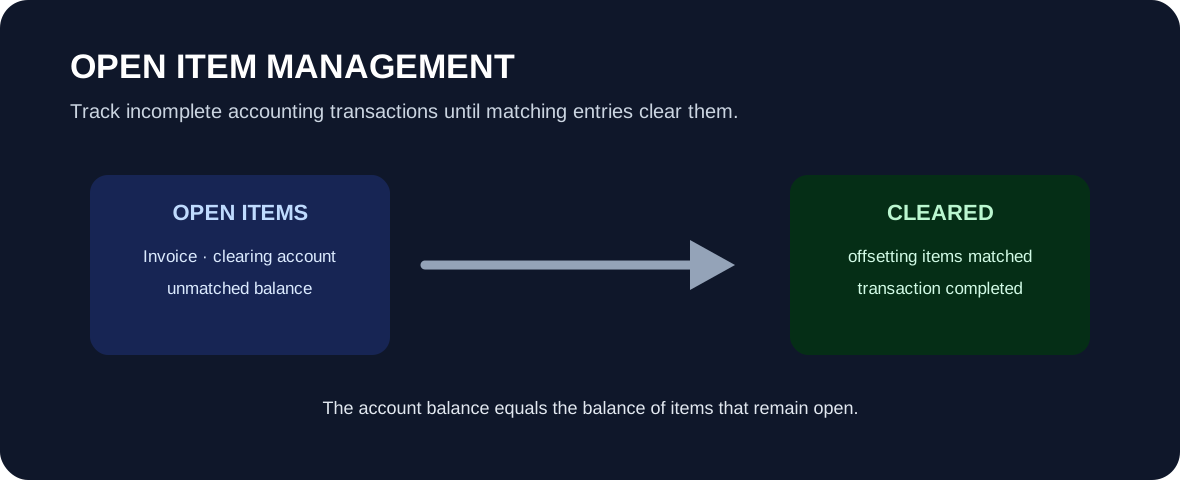
In SAP FI, open item management is used when a business needs to track individual accounting line items until they are matched by offsetting entries. A posting to an open-item-managed account begins as open. When suitable debit and credit items are cleared, those items become cleared. For such an account, SAP documents that the account balance equals the balance of the items that remain open.
Why open item management exists
A total account balance can tell Finance how much remains outstanding, but it does not by itself show which underlying transactions are incomplete. Open item management adds that operational layer. It lets users see the individual obligations, receipts, clearing entries or timing differences that still require resolution.
Customer and supplier accounts are naturally managed on an open-item basis because businesses must know which invoices remain unpaid. For selected balance-sheet G/L accounts, the same concept is useful when individual items must be reconciled rather than viewed only as a net balance.
Where it is commonly useful
SAP Help recommends open item management for examples such as bank clearing accounts, GR/IR accounts and payroll clearing accounts. The common characteristic is that an item represents something temporary or incomplete and should eventually be matched against another posting.
The setting is therefore a design decision, not a default for every G/L account. A normal balance-sheet account whose history is analyzed mainly through totals may not need item-by-item clearing. An account used to track unsettled differences often does.
What clearing actually means
Clearing does not delete the postings. It links items that together settle the open transaction and changes their status from open to cleared. SAP states that items and their offsetting items must balance to zero before they can be cleared. Finance can perform manual clearing or use automatic clearing where grouping rules and matching criteria make automation appropriate.
Changing the setting requires care
Open item management affects both account master data and existing journal-entry line items. SAP provides a controlled job for activating or deactivating open item management for G/L accounts, including consistency checks and a recommended test run. The exact procedure differs depending on whether postings already exist, so this is not a field that should be changed casually in production.
Regular, extended and ledger-group-specific open item management
S/4HANA also has specialized variants. SAP documents extended open item management for GR/IR scenarios and open item management by ledger group for certain parallel-accounting needs. These have additional rules and should not be assumed to behave exactly like ordinary open item management.
Controls a consultant should think about
- What business event creates the open item?
- What later event should clear it?
- Which fields are reliable matching criteria?
- Who reviews aged or unmatched items?
- How are genuine differences written off or reclassified?
- Would automatic clearing improve control, or could it hide poor matching logic?
This topic connects directly to G/L account master data, because the account setting governs the behavior; to posting keys and debit-credit control, because postings create the line items; and to validations and substitutions, which may support data-quality rules around postings. The next natural topic is automatic and manual clearing.
Key takeaway
Open item management is valuable when Finance needs to know not only the account balance but which specific transactions remain unresolved. Good design pairs the technical setting with a clear business definition of what creates an open item, what clears it, and who owns exceptions.