
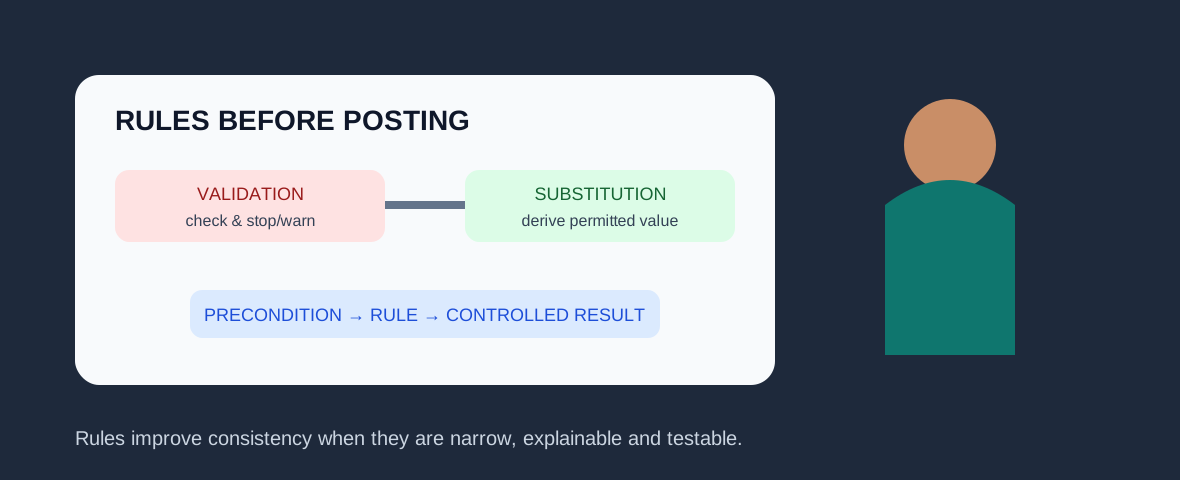
Validations and substitutions are rule-based controls used during FI-related postings. A validation evaluates conditions and checks whether data is allowed, often issuing a warning or error when the rule is violated. A substitution can populate or replace supported fields according to defined preconditions and rules. The available fields and behavior depend on the business context and SAP edition.
Validation and substitution solve different problems
A validation asks: “Given this posting context, is the entered combination acceptable?” A substitution asks: “Given this context, can the system derive a permitted value automatically?” This distinction is important because substitution should not be used to silently repair fundamentally incorrect business data.
SAP S/4HANA Cloud documents substitution and validation rules for contexts such as Journal Entry, Journal Entry Item and Coding Block, with the available fields depending on the selected context.
How to think about the rule structure
A robust rule usually has three parts: a precondition that identifies when it applies, the check or derivation itself, and the resulting message or substituted value. Narrow preconditions reduce unintended side effects. If a rule should apply only to a particular account type, document type, company code or posting scenario, encode that scope explicitly rather than relying on user knowledge.
Where consultants should be careful
SAP documents restrictions around which fields can be substituted, and some account-assignment fields are deliberately protected to preserve consistency. For example, in the Coding Block context real account assignments are generally not substituted, with limited exceptions documented by SAP. That is a reminder that substitution is not a universal override mechanism.
Also distinguish validations and substitutions from field status. Field status controls whether a field is required, optional or suppressed at entry. Validation checks a business condition. Substitution derives a value. These controls can work together but should not be confused.
Testing strategy
Test the positive case, the negative case, boundary values, reversal or follow-on processes, and any integration scenario that uses the same posting context. SAP documentation notes that rules can be triggered across processes such as journal entry, goods receipt, incoming invoice and payment depending on the chosen business context, so regression scope matters.
Common mistake
A common anti-pattern is creating a broad substitution because master data or upstream processes are inconsistent. That may make postings pass while hiding the real data-quality problem. Prefer fixing the source of error where practical and use substitution where the derivation is a legitimate business rule.