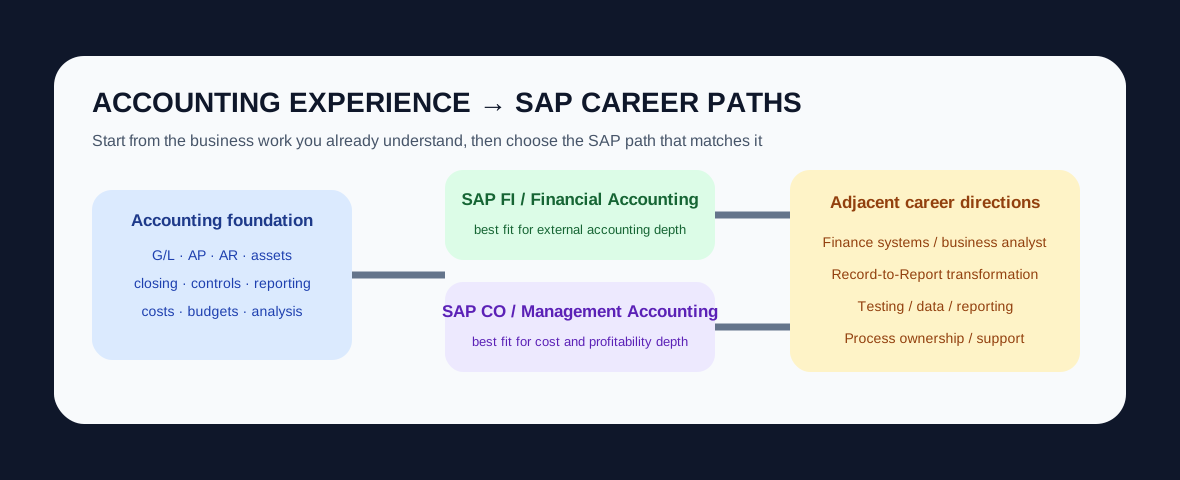
For most accountants, SAP FI is the most direct SAP path because it aligns with general ledger, payables, receivables, asset accounting, tax-related postings, banking and financial close. Management accountants may also fit SAP CO and profitability or product-costing work. Depending on experience and interests, other credible paths include treasury, group reporting, central finance, analytics, finance transformation, testing, data migration and finance business-process roles. Choose by matching the finance work you genuinely understand with the SAP work you want to perform.
Why accounting experience transfers well
SAP finance work is not only about knowing screens or configuration. Consultants and analysts need to understand why a posting exists, which business event created it, how subledgers reconcile to the general ledger, what period-end controls are required, and what financial statements should show.
An accountant already brings part of that reasoning. Experience with journals, reconciliations, month-end close, receivables, payables, fixed assets, cost allocation or reporting gives context that a purely technical learner may need to build from scratch. The gap is learning how those processes are represented, controlled and integrated in SAP.
Path 1: SAP FI — the most direct fit
SAP FI is the natural starting point for accountants who enjoy financial accounting and close processes. The domain foundation includes general ledger, accounts payable, accounts receivable, fixed assets, bank-related accounting, taxes, foreign currency and period-end reporting.
If you can explain why transactions post, how balances reconcile and which controls matter, you already possess valuable context. You still need SAP-specific knowledge: organizational structure, master data, document controls, integration, configuration concepts, testing and how S/4HANA Finance represents accounting data.
Start by understanding how much accounting knowledge SAP FI requires, then use the SAP FI / FICO knowledge hub to connect finance concepts with SAP structure.
Path 2: SAP CO and management accounting
If your experience is closer to budgeting, cost centers, product costing, profitability, variance analysis or management reporting, controlling may be a stronger fit than pure financial accounting. SAP S/4HANA integrates financial and management accounting closely, but the business questions remain different: FI emphasizes external accounting and statutory reporting, while controlling focuses more on internal cost and performance management.
Cost accountants, plant accountants and management accountants can therefore bring particularly useful domain depth to CO-oriented roles.
Path 3: specialized finance solutions
Some accountants have experience that points beyond core FI. Treasury professionals may explore SAP Treasury and Risk Management or Cash Management. Consolidation specialists may be interested in SAP S/4HANA Finance for group reporting. People working on finance-system harmonization may encounter Central Finance. Credit, collections and dispute specialists may align with financial supply-chain processes.
These are usually better treated as specialization paths after establishing the relevant accounting and SAP foundations. A narrow product name should not replace understanding of the underlying finance process.
Path 4: finance transformation and business-process roles
Not every accountant moving into SAP needs to become a configuration-heavy functional consultant. Finance transformation teams need people who can map current processes, define controls, explain reporting needs, support Fit-to-Standard workshops, test end-to-end scenarios, prepare data, train users and help business teams adopt new ways of working.
This can be a strong path for experienced accountants who enjoy process improvement and stakeholder work. The article on how domain experience changes an SAP career path explains why deeper business experience can shift the most credible entry point.
A practical fit matrix
What if your accounting experience is very narrow?
A specialist AP or AR role is still useful, but broaden your understanding before presenting yourself as an end-to-end finance consultant. Learn how your sub-process connects to procurement, sales, banking, general ledger and close. For example, an AP professional should understand why a purchase order and goods receipt affect invoice verification and accounting, not only how an invoice is posted.
That breadth makes your existing experience more transferable because SAP implementations are built around integrated processes rather than isolated job descriptions.
Do you need certification first?
Certification can be useful, but it does not replace process understanding or credible practice. SAP certification: when it helps and when it does not separates credential value from actual job readiness. An accountant should prioritize the ability to explain finance processes, SAP concepts, integration and realistic business scenarios.
Consultant thinking: build on what you can defend
In interviews and project conversations, credibility comes from being able to connect system behavior to a finance consequence. Instead of claiming broad “SAP experience” too early, show how your accounting background helps you reason about postings, controls, exceptions and reconciliation — and be clear about which SAP capabilities you are still building.
Key takeaway
Most accountants have a strong starting advantage for SAP finance careers, but there is no single mandatory route. SAP FI is the most direct path; CO, treasury, group reporting, analytics and finance transformation can fit different backgrounds. Choose the path where your real accounting knowledge gives you useful business context, then add SAP process, integration, testing and system capability on top.