
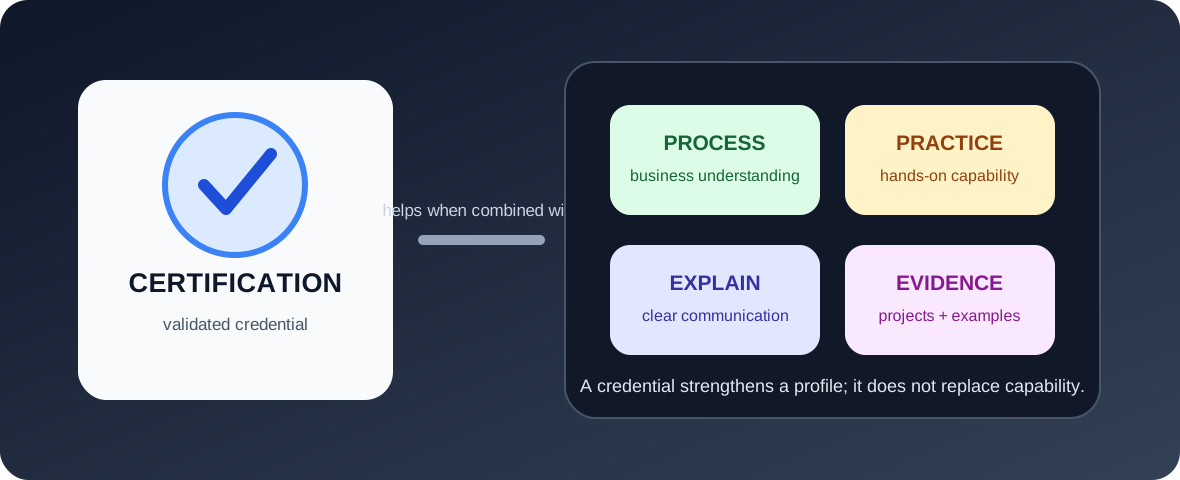
SAP certification can help when a target role, employer or project values a current SAP credential and when the certification matches the capability you are actually building. It is less useful when it is pursued without process understanding, hands-on practice or a realistic target role. Passing an assessment is evidence of assessed knowledge at a point in time; it is not proof of project experience, consulting judgement or job readiness by itself.
What SAP certification actually represents
SAP's current certification model is tied to specific solution skills and learning journeys. SAP Learning provides certification information, preparation resources and ongoing guidance for maintaining credentials as products evolve. The exact certification portfolio, assessment format and validity or renewal requirements can change, so learners should verify the current official SAP Learning information for the credential they are considering.
The useful mental model is simple: certification is a credential. It signals that you met SAP's assessment requirement for a defined area. Training and practice are the activities that build the underlying capability. That distinction is explained further in SAP training vs SAP certification.
When certification can help
- The employer or role explicitly values it. A relevant credential can help satisfy a stated screening preference or demonstrate structured study in a defined SAP area.
- You already have a coherent learning path. Certification can consolidate learning when you understand the business process, have practiced the solution and can explain what you know.
- You need a credible external milestone. For someone without prior SAP employment, an official credential can be one piece of evidence that study was serious and structured.
- Your organization requires or encourages current credentials. Employers and SAP ecosystem participants may have their own capability or credential expectations.
- You are updating skills for a changing SAP product area. A current certification can support a broader upskilling plan when paired with real application.
When it helps less than people expect
Certification does not manufacture project experience. It does not prove that you can facilitate a workshop, diagnose a production issue, configure an end-to-end process, design an integration, write a good functional specification or manage a difficult stakeholder. Those capabilities develop through deeper learning and applied practice.
It also cannot rescue a poorly chosen career direction. If you selected a module only because you heard it was “in demand,” but you dislike the underlying work or lack the relevant foundation, adding a credential does not fix the mismatch. Start with how to choose your first SAP module and build depth before collecting unrelated badges.
What to build alongside certification
A stronger early-career profile combines several kinds of evidence. Be able to explain the end-to-end business process in plain language. Understand where your SAP area fits with adjacent functions. Practice realistic scenarios without claiming client experience you do not have. Learn to document assumptions, test outcomes and process decisions. Be able to discuss errors and trade-offs rather than only memorized definitions.
This is why job readiness is better judged through capability milestones than through one exam date. Employers ultimately need people who can understand work, communicate clearly and solve problems within their level of responsibility.
A practical decision test
- What exact role am I targeting?
- Is this certification relevant to that role and current SAP product direction?
- Does the employer or market I am targeting value the credential?
- Can I already explain the business process behind the solution?
- Have I practiced enough to discuss realistic scenarios rather than only exam topics?
- Will certification strengthen my evidence, or am I using it to postpone building practical capability?
Key takeaway
SAP certification can be valuable, but its value is contextual. Treat it as a supporting credential within a broader capability plan. The strongest candidate is not the person with the longest badge list; it is the person whose learning, practical evidence, target role and credential choices tell one credible story.