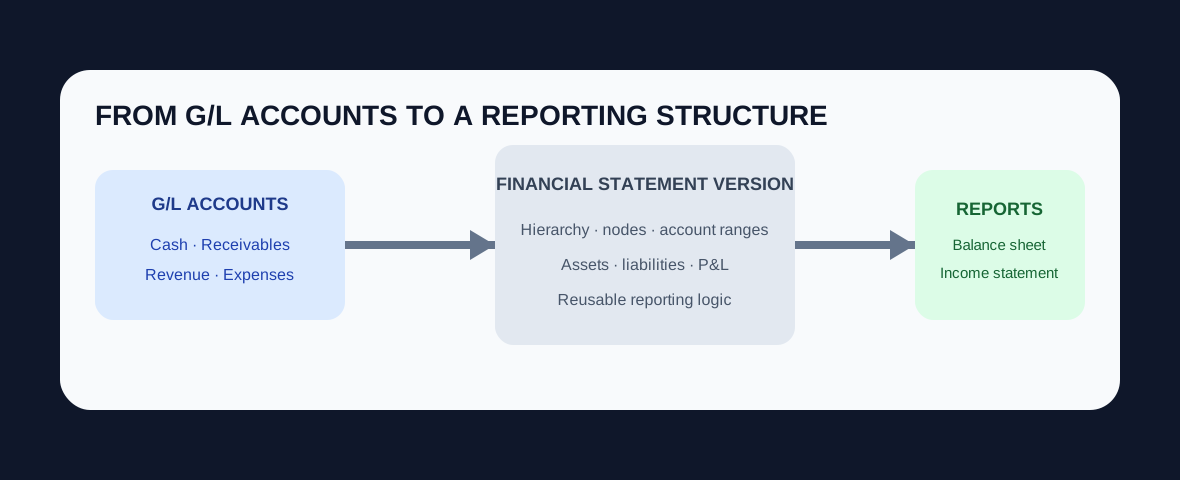
A financial statement version (FSV) is a hierarchical reporting structure that assigns G/L accounts to financial statement items. It lets SAP present ledger balances under headings such as assets, liabilities, equity, revenue and expenses. One chart of accounts can support different reporting views through different FSVs, provided account mappings are maintained completely and consistently.
Why an FSV exists
The general ledger stores balances by account. Financial statements need those balances grouped into meaningful reporting lines. SAP Help describes financial statement versions as structures used for financial statement reporting, and SAP documentation for financial statement analysis notes that reports can technically be based on an FSV.
This separation is useful because the operational account structure and the presentation structure are not always identical. Finance may need a statutory view, a management view, a country-specific view, or a group-oriented structure without renumbering the underlying G/L accounts.
How the hierarchy works
An FSV contains nodes and subnodes representing financial statement items. G/L accounts or account ranges are assigned to those items. The hierarchy then controls how balances roll up into sections and totals. SAP also provides country- or scenario-specific financial statement versions in some delivered content, while customers may copy, adapt or maintain structures to fit their requirements.
What can go wrong
The most common risk is incomplete or incorrect account assignment. A newly created G/L account may post correctly but fail to appear in the intended statement line until the FSV is maintained. SAP best-practice guidance explicitly calls for maintaining the FSV when additional G/L accounts are introduced in relevant scenarios.
Another risk is assuming one FSV must satisfy every reporting audience. If statutory, local and management presentation needs differ, separate governed structures may be clearer than overloading one hierarchy with conflicting purposes.
Relationship with other FI concepts
The FSV organizes balances for presentation; it does not create the balances. Those balances come from posted journal entries, including period-end effects such as foreign currency valuation. Parallel ledgers can hold accounting-principle-specific values, while the FSV provides the reporting hierarchy used to display them. Reporting dimensions such as profit center and segment answer a different question: which responsibility or reportable unit the balance belongs to.
Controls that matter
- Account onboarding: include FSV mapping in the control checklist for every new relevant G/L account.
- Ownership: define who approves changes to statement hierarchy and account ranges.
- Completeness: review unassigned or unexpectedly classified accounts before financial reporting is finalized.
- Change discipline: assess whether reorganizing nodes changes comparative reporting or downstream report logic.
- Multiple views: use separate structures where different reporting purposes genuinely require them.
Consultant thinking: design from the reader backward
Start with the statement Finance must explain. Identify the required headings and subtotals, then map the chart of accounts into that presentation. The design should let a reviewer trace a reported number back to the contributing G/L accounts without ambiguity.
Key takeaway
A financial statement version is the bridge between ledger account balances and a readable financial statement hierarchy. Its value is not in changing accounting entries, but in making sure the right balances appear under the right reporting headings with controlled, traceable mapping.