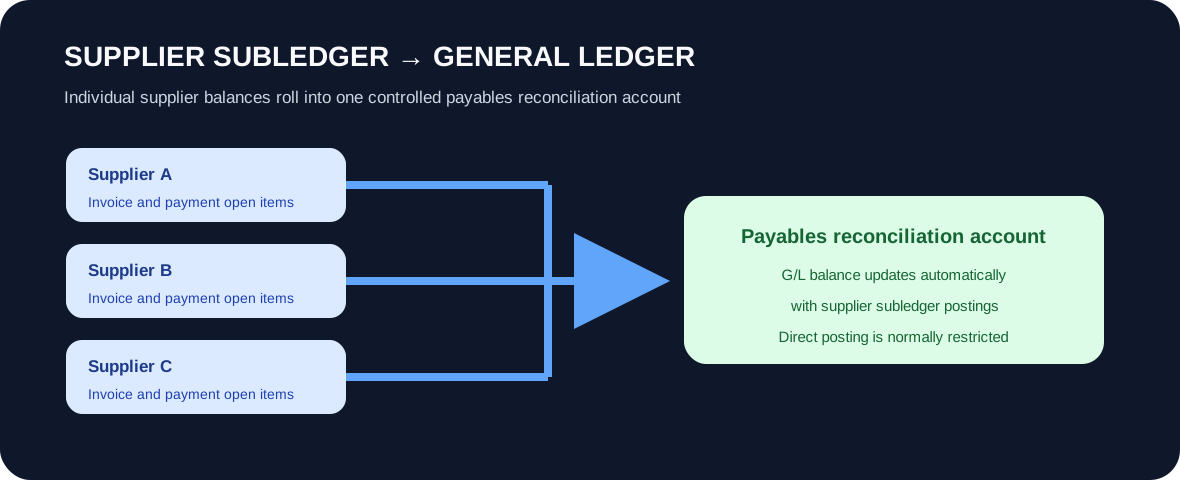
In SAP FI, a supplier reconciliation account is a general-ledger account assigned to supplier company-code data. When an invoice, credit memo or payment is posted to a supplier, SAP updates the supplier subledger and the assigned reconciliation account automatically. That gives operational supplier detail and a controlled payables total in the G/L without maintaining both separately.
Why reconciliation accounts exist
Accounts Payable needs supplier-level open items, clearing history and balances. Financial reporting needs a summarized trade-payables position in the general ledger. Reconciliation accounts connect those views so the G/L balance is driven by the same transactions that create supplier detail.
SAP Learning explains that reconciliation accounts receive postings from subsidiary ledgers and that subledger postings are reflected automatically in the assigned reconciliation account. The business consequence is important: supplier detail and the control account are synchronized by posting logic rather than by a separate manual reconciliation journal.
Where the reconciliation account is assigned
For suppliers, the reconciliation account is maintained in accounting data for the relevant company code. That scope matters because the same Business Partner may be extended to more than one company code, while each legal entity can require its own accounting settings. The G/L account itself must also be identified for the correct reconciliation-account type.
This is why a reconciliation account is not simply a balance-sheet account chosen by convention. Its configuration tells SAP that supplier subledger transactions should update it automatically.
What happens when a supplier invoice is posted
Assume a company posts a supplier invoice for 100,000. The posting creates an open item on the supplier account and a corresponding credit to the assigned reconciliation account. The debit side depends on the transaction—expense, inventory, GR/IR or another account—but the supplier liability reaches the G/L through the reconciliation account.
When the supplier is paid, the supplier item is cleared and the reconciliation-account balance reduces through the same accounting transaction. Supplier open-item processing and G/L payables therefore stay aligned when master data and postings are correct.
Why direct posting is restricted
If users could routinely post manual journals straight to a supplier reconciliation account, the G/L balance could change without a corresponding supplier item. That would break the control relationship the account is meant to preserve. SAP Learning explicitly notes that amounts cannot be posted directly to reconciliation accounts.
Controls consultants should verify
Check that the G/L account is configured for the correct reconciliation type, that supplier company-code data points to the intended account, and that changes to the field are governed. Different supplier populations may legitimately use different reconciliation accounts, but the design should follow real reporting or control requirements rather than unnecessary fragmentation.
At period end, investigate differences by tracing supplier postings, master data and configuration rather than forcing the control account to match with an unsupported manual journal.
Related concepts
The reconciliation account gives the G/L total while the supplier subledger explains what makes up that total. Continue with Open Item Management in SAP FI, Automatic and Manual Clearing, and Supplier Business Partner Master Data. Browse the wider SAP FI / FICO hub for the surrounding accounting structure.
Key takeaway
A supplier reconciliation account is the controlled G/L representation of supplier subledger activity. Post to the supplier, let SAP update the reconciliation account automatically, and protect the configuration so supplier detail and the general-ledger balance stay aligned.