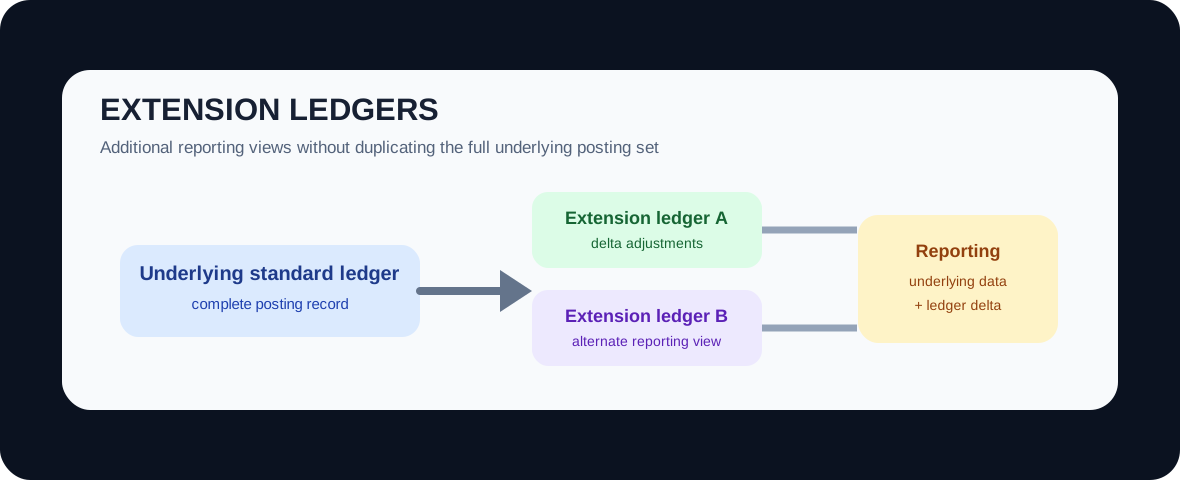
In SAP S/4HANA Finance, an extension ledger is a dependent ledger that sits above an underlying standard ledger. SAP states that it inherits the underlying ledger's configuration and does not physically duplicate all of its postings. Instead, it stores only additional entries made specifically to the extension ledger. Reporting on the extension ledger combines those delta postings with the underlying ledger data. This makes it useful when the business needs an extra controlled accounting view but does not need a fully independent ledger.
Why extension ledgers exist
Finance teams often need more than one perspective on the same base accounting data. A statutory view may be correct as posted, while management wants a separate adjustment layer. A consolidation process may need entries that should not affect local books. A restatement exercise may require temporary or specially governed adjustments.
The design question is whether the second view needs a complete independent posting record or simply a difference from the existing ledger. A second standard ledger carries a full posting set and can support more independent configuration. An extension ledger is intentionally lighter: the underlying ledger remains the base, and the extension stores the delta.
What the extension ledger inherits
SAP Help explains that extension ledgers inherit the configuration of their underlying ledger. That means the relationship is structural, not merely a reporting convenience. The extension ledger depends on the underlying ledger for the base posting information and key settings.
One important consequence is that an extension ledger cannot be used when the additional accounting view requires completely different currency settings or a different fiscal-year variant. SAP explicitly identifies those needs as cases where an additional standard ledger may be necessary instead.
Extension ledger versus an additional standard ledger
The distinction becomes clearer when you compare independence. A standard ledger contains the full posting record and its own ledger-level settings. An extension ledger uses an existing standard ledger as its foundation, so it offers lower duplicated storage but less configuration freedom.
Typical business uses
SAP documentation describes extension ledgers as a way to support additional financial views, including manual adjustments that differ from an underlying ledger. The broader pattern is that the operational accounting remains valid, but another governed view needs a controlled layer of additional postings.
That can support management adjustments, restatement scenarios, tax-oriented entries, simulation-style views or consolidation-related adjustments, depending on the extension-ledger type, deployment edition and release. The specific posting scope should always be checked before design approval because extension ledgers have restrictions and are not a universal substitute for standard ledgers.
Important design controls
- Define the purpose: document exactly why the additional view is needed and who consumes it.
- Check configuration independence: if currencies or fiscal-year settings must differ, evaluate an additional standard ledger.
- Check supported postings: confirm that the required business transactions are allowed in the chosen extension-ledger type.
- Govern adjustments: define who can post, which periods are open, which document types are permitted, and how approvals work.
- Validate reporting: confirm that the reports, extracts and downstream processes use the intended ledger view.
How this connects to the wider S/4HANA finance architecture
Parallel ledgers and accounting principles explain the broader need for multiple accounting perspectives. Extension ledgers are one architectural option within that design. They are particularly useful when the extra perspective can inherit a base ledger rather than operate independently.
The concept also sits on top of the Universal Journal, which provides the shared accounting line-item foundation for S/4HANA Finance. Once the ledger architecture is defined, financial statement versions help organize those balances into governed reporting structures.
Consultant thinking: start with the accounting difference
A good design workshop should not begin with the configuration object. It should begin with the difference the business needs to represent. Is the alternative view simply a small set of adjustments? Does it need different currencies? Does it have a different fiscal calendar? Are all required postings supported? Who owns the adjustment process, and how must it be audited?
If the difference is a controlled delta layered over a stable base, an extension ledger can be an efficient solution. If the difference requires a complete independent accounting record, an additional standard ledger is usually the more natural architecture.
Key takeaway
An extension ledger is a dependent ledger that inherits an underlying standard ledger and stores only additional delta postings. It reduces duplication when the extra accounting view can share the same base configuration, but it is not suitable for every parallel-accounting requirement. The correct choice comes from the degree of accounting independence the business actually needs.