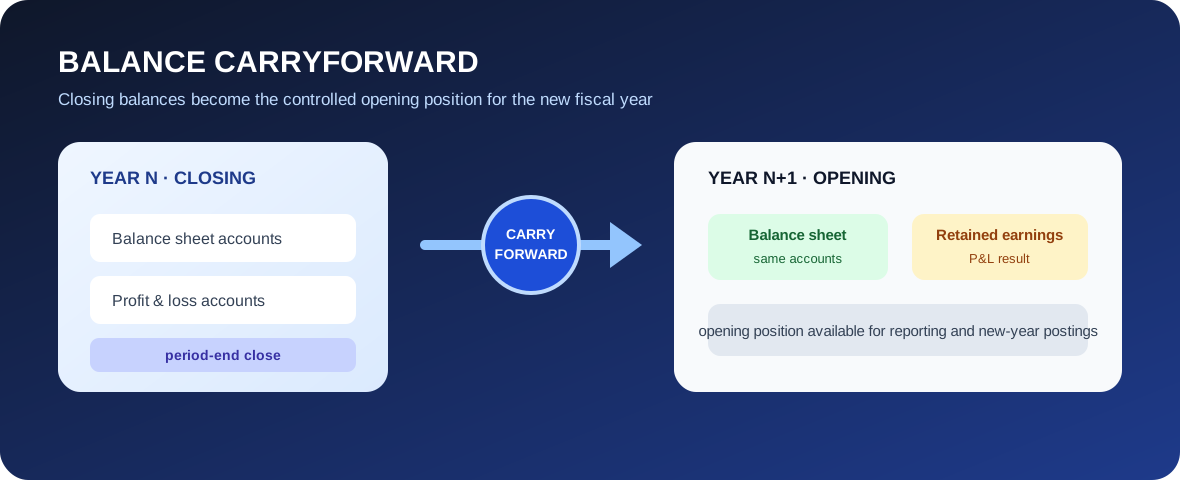
Balance carryforward is the year-transition process that makes prior-year closing balances available as opening balances in the new fiscal year. Balance-sheet accounts normally carry forward to the same accounts. Profit-and-loss accounts do not remain open as ordinary P&L balances; their result is transferred through retained-earnings logic so the new fiscal year starts with P&L accounts reset while equity reflects the prior-year result.
Why balance carryforward exists
Financial reporting depends on continuity. Cash, receivables, payables, inventory-related balances, fixed assets and other balance-sheet positions still exist when the calendar or fiscal year changes. Without a controlled carryforward, the new fiscal year would not begin from the previous year's closing financial position.
SAP Help describes balance carryforward as carrying account balances in all relevant currencies into the new fiscal year. It also distinguishes the treatment of balance-sheet accounts from profit-and-loss accounts: balance-sheet balances continue on the same accounts, while P&L balances feed retained earnings.
Balance-sheet accounts and P&L accounts behave differently
For a balance-sheet account, the purpose is continuity. If the business closes the year with a bank balance, customer balance, supplier balance or other balance-sheet amount, that position needs to exist when the next fiscal year opens.
For profit-and-loss accounts, the accounting logic is different. Revenue and expense accounts measure performance for a period. Their balances are therefore not carried into the next year as if the new year's revenue and expenses had already occurred. Instead, the prior-year result contributes to retained earnings according to the configured accounting logic.
What happens when prior-year postings continue
Year-end work often overlaps with the opening of the next fiscal year. Adjustments may still be posted to the prior year after an initial carryforward has run. SAP S/4HANA documentation explains that carried-forward balances can be updated when postings are made to the previous fiscal year, so Finance should understand the edition-specific execution and monitoring behavior rather than treating carryforward as a one-time static copy.
In SAP S/4HANA Cloud Public Edition, SAP documents automatic scheduling around fiscal-year start and also provides a way to schedule the Balance Carryforward job manually. Other deployment models can use different programs, jobs or operating procedures. The business principle is the same: the opening position must reflect the final prior-year close.
Controls Finance should perform
- Reconcile close to open: compare the previous year's ending balances with the new year's opening balances at the required ledger and currency level.
- Check retained earnings: confirm that the P&L result has moved to the intended retained-earnings account or accounts.
- Watch late postings: understand how prior-year adjustments update the new-year opening position.
- Review account assignments: carryforward configuration and account characteristics can affect the level of detail preserved.
- Coordinate with closing: do not treat carryforward as isolated from valuation, accruals, reconciliation and financial-statement review.
How it connects with nearby FI topics
Financial statement versions determine how the carried-forward balances are presented in reports. Foreign currency valuation can change period-end balances before the final close. Open item management matters because individual receivables, payables and other open items can remain outstanding across the year boundary even though total account balances are carried forward.
In other words, carryforward is not a substitute for closing controls. It is the bridge that lets the verified closing position become the next year's opening position.
Consultant thinking: separate accounting logic from job mechanics
When users ask, “Did we run balance carryforward?”, the better follow-up is, “What opening result do we expect, and how will we prove it?” The job or program is only the mechanism. The business requirement is continuity, correct P&L closure and reconciled opening balances.
Key takeaway
Balance carryforward connects fiscal years. Balance-sheet balances continue, P&L results move into retained earnings, and Finance must verify that the new year's opening position faithfully reflects the prior year's close — including any approved late adjustments.