
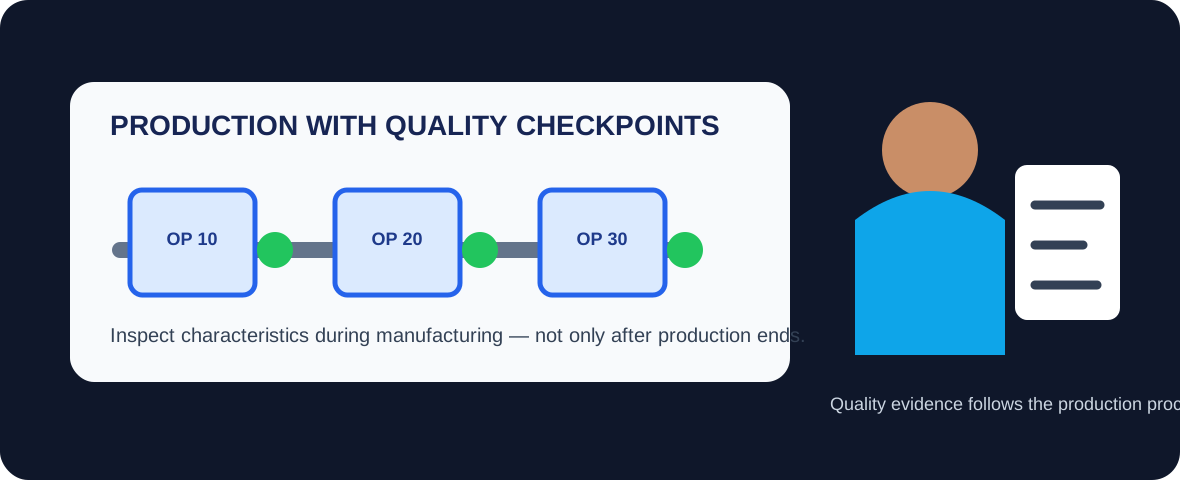
In SAP Quality Management, quality in production means inspecting defined characteristics while manufacturing is underway rather than relying only on a final check. Depending on the inspection setup, SAP can create an inspection lot in connection with a production or process order, support results recording at defined inspection points, and keep the quality record tied to the manufacturing context.
Why inspect during production?
A final inspection can tell a business that finished output is wrong, but it may be too late to avoid scrap, rework or lost capacity. In-process quality checks move control closer to the operation where variation occurs. Operators and quality teams can see whether a critical dimension, temperature, weight, composition or other characteristic remains within the required range before more value is added.
The business objective is not “more inspection.” It is earlier evidence at the point where action is still practical.
How SAP connects inspection to production
SAP documentation describes inspection during production using inspection lots associated with production or process orders. For the relevant inspection setup, an inspection lot can be created when the order is released. The inspection plan or routing defines the characteristics to be checked and can use inspection points so results are recorded repeatedly for specific operations, quantities or other defined reference points.
This makes the quality record more useful than a detached checklist. Results can be associated with the manufacturing context in which they were observed.
Inspection points matter when one result is not enough
A production operation may run for hours or produce many units. One measurement for the whole order may hide variation. Inspection points let the process capture repeated results according to the business design—for example by operation, time, quantity or another defined reference. The exact design should follow the control need, not an arbitrary desire to collect more data.
Quality in production is different from final inspection
In-process inspection answers, “Is the process behaving correctly while we are making the product?” A final inspection, when used, asks whether completed output meets the release criteria at the end. They can complement each other, but they solve different control problems.
It is also important not to assume that every production-related inspection has the same stock behavior. SAP distinguishes scenarios and inspection types; some production inspections are focused on process monitoring and are not stock relevant in the same way as inspections connected to goods receipt.
Where this fits with the existing SAP QM foundation
The production-quality design builds on concepts already used elsewhere in QM. The inspection lot is the operational container for inspection processing, the inspection plan defines what should be inspected, and master inspection characteristics help standardize what is measured. The production context determines when and where those controls are applied.
What a consultant should ask
- Which production characteristics are genuinely critical to quality?
- At which operation can a bad result still be corrected economically?
- How often should results be recorded, and what should define an inspection point?
- Who records results: production, quality, or an automated measurement source?
- What happens when a result is outside tolerance—stop, rework, adjust, escalate, or continue under an approved rule?
- Does the scenario require a later stock-relevant or final quality decision as well?
Key takeaway
Quality in production is most valuable when it shortens the distance between detecting variation and acting on it. SAP QM provides the inspection structure, but the business must decide which characteristics, operations, frequencies and reactions create meaningful control.