
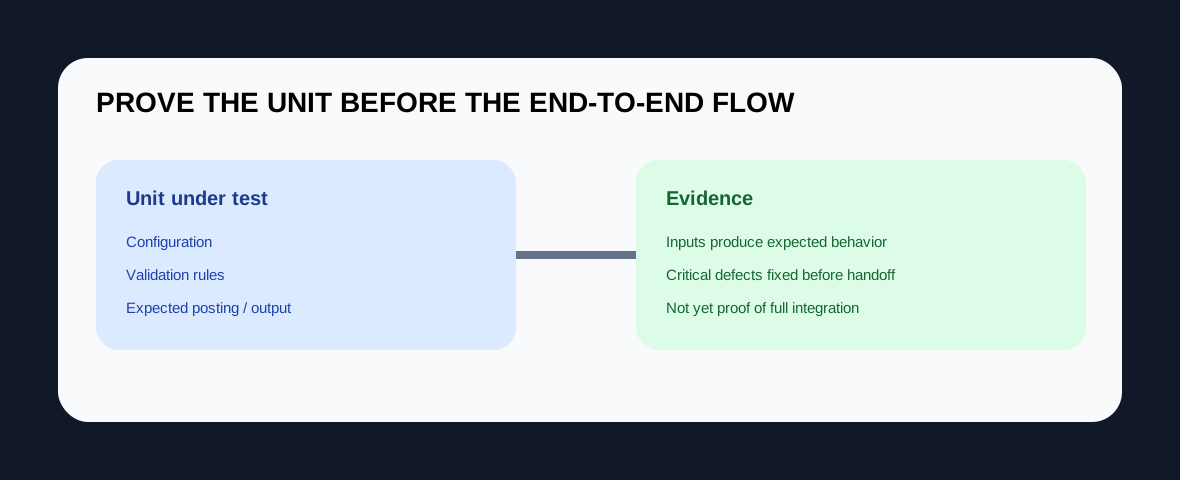
Unit testing in an SAP project proves that a specific configuration, rule, development or functional building block behaves as expected for the test cases executed. It helps the functional or technical team catch defects early before broader process testing. It does not prove cross-system integration, complete end-to-end process performance or business-user acceptance; those are covered by later test levels.
What counts as a unit
In a functional workstream, a unit may be a configured posting rule, pricing condition, approval rule, form trigger, master-data control or another bounded design element. In technical work, a unit may be a program component, method or service logic. The exact boundary depends on the project.
SAP Learning implementation guidance describes unit testing as testing configuration, typically by functional and technical teams, before integration testing and UAT. Separate SAP development guidance describes code unit tests as isolated tests of individual functions or methods.
What a passing unit test proves
A pass gives bounded evidence that the unit behaved as expected under the tested conditions. It can confirm configuration values, validation logic, calculation results, posting behavior, status changes or other outputs. It also gives the team confidence that critical and high-priority defects in that unit have been addressed before wider testing.
What it does not prove
A unit may pass while the end-to-end process still fails. Integration points can break, data may map incorrectly between systems, authorizations may differ for real users, or downstream steps may behave differently. SAP Learning distinguishes integration testing as the stage that confirms interfaced data exchange and UAT as the stage that validates complete business processes against approved requirements.
What good unit-test evidence looks like
Record the requirement or design reference, preconditions, input data, steps, expected result, actual result, pass/fail status and supporting evidence. If the test fails, log the defect and retest after correction. The evidence should show what was actually proved, not merely that someone clicked through a transaction.
Consultant thinking
Good unit testing is intentionally narrow. If a test case contains too many integrated steps, it becomes harder to identify which unit caused the failure. Conversely, tests that are too trivial may prove little. Choose a scope that isolates meaningful configured behavior and includes both positive and negative conditions.
Continue with How Testing Scope Is Defined, How Transactional Data Is Prepared for Testing, How Master Data Is Prepared for Testing, and the Consulting & ERP Projects hub.