
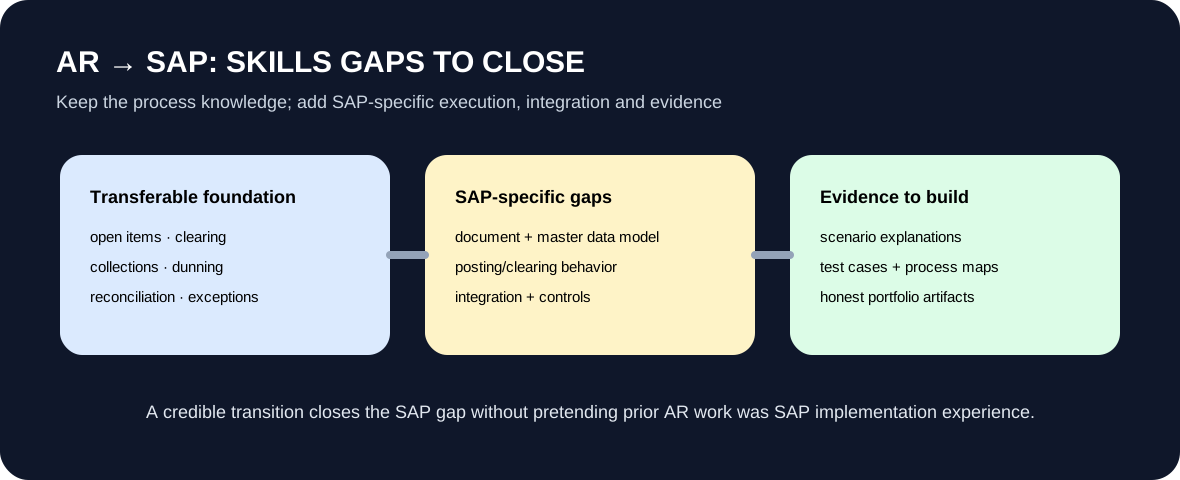
An Accounts Receivable professional moving into SAP usually does not need to relearn the business purpose of receivables. The main gaps are SAP-specific: how Business Partner and company-code data work, how financial documents and open items are represented, how postings and clearing behave, how AR integrates with sales and banking processes, how configuration changes are tested, and how to prove learning without claiming experience you have not had.
Gap 1: learn the SAP document and master-data model
AR experience gives you the meaning of invoices, payments, balances and overdue items. SAP adds a structured representation of those concepts. Learn how customer accounting is represented through Business Partner and company-code data, how reconciliation accounts connect subledger activity to the general ledger, and how accounting documents carry posting keys, dates, amounts and references. The goal is to understand what each screen or field means in the accounting model, not merely where to click.
Gap 2: understand posting, clearing and payment differences
Cash application experience is a strong foundation, but SAP has explicit posting and clearing behavior. Build confidence explaining how an invoice creates an open item, how incoming payment processing clears or partially clears it, what can happen when amounts differ, and how unapplied or residual items affect the customer account. SAP Learning materials on receivables management are useful because they connect business events to system behavior.
Gap 3: connect AR to the wider SAP process
Receivables do not operate in isolation. Customer invoices can originate from sales and billing processes, payments interact with bank-statement and cash processes, dunning can influence collections activity, and every subledger posting affects financial reporting. You do not need to master every adjacent module at once, but you should be able to explain where AR receives information from and where its outputs matter.
Gap 4: build testing and control thinking
Knowing how a process should work is different from proving that a configured SAP process works. Learn to turn business rules into test cases with a clear starting condition, action, expected result and evidence. Include exceptions such as partial payments, overpayments, blocked or disputed items, incorrect master data and overdue balances. This helps translate operational judgement into implementation-relevant thinking without overstating prior project ownership.
Gap 5: make your evidence truthful
A portfolio can demonstrate process maps, scenario explanations, sample test cases, configuration-learning notes and issue-analysis exercises. It should not imply that you configured a production client, owned cutover, transported changes or led an implementation unless you actually did. The strongest transition story is precise: “I know AR deeply, I have learned how SAP represents it, and here is the evidence of that learning.”
Continue with Best-Fit SAP Paths for AR Professionals, Which AR Skills Transfer Into SAP, How to Build a Transition Portfolio, the SAP FI / FICO hub, and the Careers & Career Switching hub.