
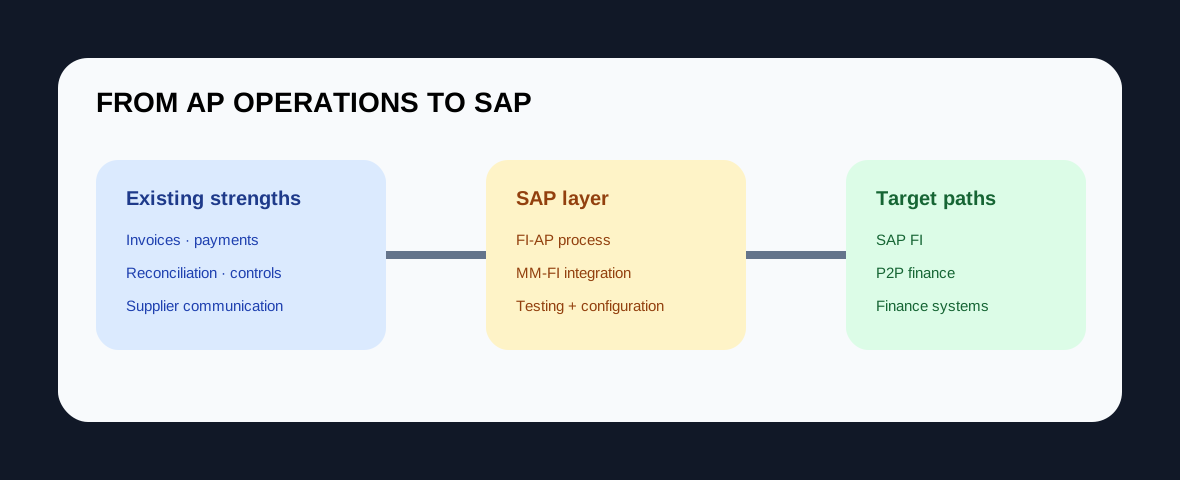
The most natural SAP paths for an accounts payable professional are usually SAP FI with an AP focus, procure-to-pay or invoice-to-pay finance roles, finance systems or business-analysis roles, and eventually broader finance transformation work. The strongest path depends on whether you want to stay close to accounting operations, move toward configuration and testing, or broaden into cross-functional process design.
Why AP experience transfers well
SAP Learning describes Accounts Payable Accounting as the area that records business transactions related to supplier relationships and notes its close connection with Materials Management. That mirrors the real work many AP professionals already know: supplier invoices, payment terms, payment runs, reconciliations, exceptions, procurement references and period-end responsibilities.
The transition advantage is therefore business-process familiarity. The gap is SAP-specific capability: organizational structure, Business Partner data, reconciliation accounts, posting logic, invoice verification, configuration concepts, integration, testing and project documentation.
Path 1: SAP FI with an Accounts Payable focus
This is the closest fit. You deepen knowledge of supplier master data, reconciliation accounts, invoice and credit-memo posting, payment terms, payment methods, payment blocks, clearing, withholding tax and period-end AP activities. Over time, you broaden from AP into the rest of FI.
Path 2: Procure-to-Pay finance or invoice-management work
If your current role involves purchase-order invoices, GR/IR, three-way matching or procurement exceptions, you may fit well in cross-functional P2P roles that sit between Finance and Procurement. This path requires stronger MM-FI integration knowledge and comfort discussing the end-to-end process rather than only the finance posting.
Path 3: Finance systems, testing or business analysis
Some AP professionals prefer system improvement over configuration ownership. Finance systems analyst, test analyst or business analyst work can use your process knowledge while emphasizing requirements, test cases, defect analysis, controls and user support.
Path 4: Finance transformation
With broader experience, AP knowledge can become one part of a finance-transformation profile covering process standardization, shared services, controls, automation and ERP change. This is usually a later-stage path because employers expect broader process and project exposure.
How to choose your first target
If you enjoy accounting rules and postings, start with SAP FI. If you enjoy investigating invoice exceptions across procurement and receiving, add MM-FI integration early. If you enjoy process improvement and stakeholder coordination, finance systems or business analysis may be a better initial target than a pure configuration role.
Continue with Accountant Moving Into SAP: Best-Fit SAP Paths, Vendor Invoice Posting Lifecycle, Supplier Reconciliation Accounts, and the Careers hub.