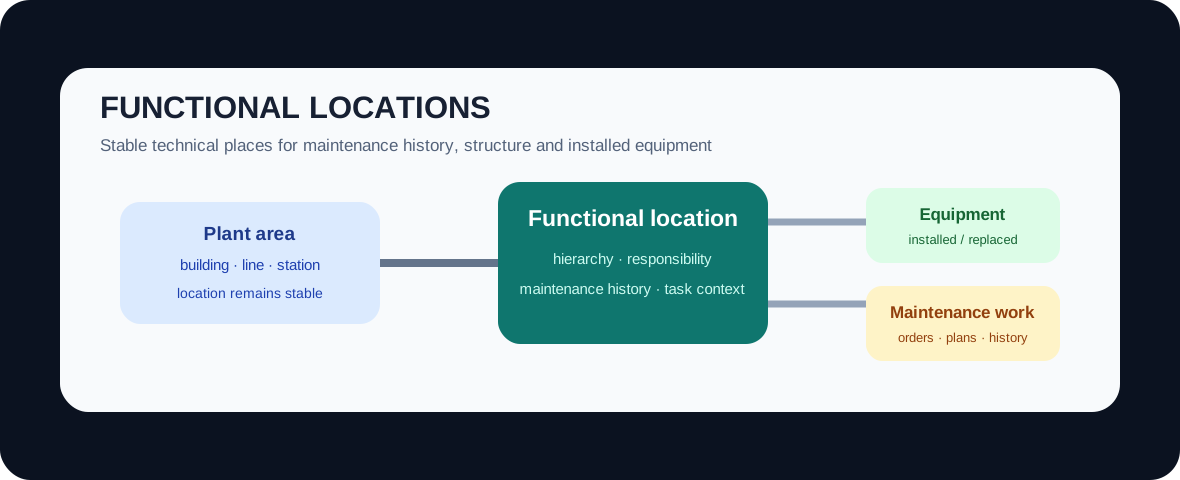
In SAP Enterprise Asset Management, a functional location is an organizational unit used to structure technical objects according to functional, process-related or spatial criteria. It identifies where a maintenance task is performed and can exist in a hierarchy. Equipment can be installed at a functional location, while maintenance history, organizational assignments and planning data can remain associated with the location itself. This is useful when the position or function remains important even as the installed equipment changes.
Why a maintenance organization needs locations as well as equipment
Imagine a pump position on a production line. The physical pump may be removed, repaired and replaced by another unit, but the process position still exists. Maintenance planners still care about the history of failures at that position, its maintenance plant, responsible work center, cost assignment and relationship to the rest of the production system.
A functional location gives that stable position an identity. Equipment gives the individual serialized asset an identity. The two can work together: the functional location says “where and for what function,” while the equipment record can say “which specific maintainable object is currently installed here.”
How the hierarchy works
Functional locations can be arranged hierarchically. SAP supports structure indicators that define how functional-location labels are built and how hierarchy levels are interpreted. A business might model site → production area → line → machine position, or building → floor → utility system → maintainable point.
The hierarchy should reflect how maintenance work is planned and analyzed, not merely copy an engineering drawing. Too much detail creates master-data overhead; too little detail makes history and responsibility difficult to interpret.
What information can be held at a functional location
Functional-location master data can include general descriptive information, location and organizational data, structure information and maintenance-related assignments. Depending on the system design, this can include maintenance plant, planning plant, work center, cost center and other data used by maintenance processing.
SAP also supports inheritance of certain data down a functional-location hierarchy. This can reduce repetitive maintenance of common values, but governance is important: teams should know which values are inherited, where an exception is allowed, and what happens when a superior location changes.
Functional location versus equipment
- Functional location: best for a stable place, function or technical position where maintenance occurs.
- Equipment: best for an individual maintainable object whose own history and identity matter, especially when it can be installed, removed or moved.
- Both together: useful when the organization wants history for the position and for the specific asset installed there.
This distinction also matters in processes such as refurbishment, where repairable equipment may move through condition states while the operational location continues to exist.
Why the design affects maintenance history
Notifications and orders can reference technical objects. If the hierarchy reflects the real maintenance organization, planners can analyze recurring problems at a location even when equipment has changed. Conversely, if everything is modeled only as movable equipment, location-specific failure patterns may be harder to see.
The design also affects preventive maintenance, reporting, cost analysis and responsibility. A well-governed hierarchy makes it easier to answer questions such as: Which production area has the most breakdown work? Which pump position repeatedly causes downtime? Which work center owns this location? Which assets are installed under this system?
Consultant thinking: model the maintenance question
Before creating hundreds of functional locations, ask what decisions the hierarchy must support. Does the business maintain by physical place, process function or both? Which positions must retain history when equipment changes? At what level are work centers and cost centers assigned? How do planners search for technical objects during a breakdown?
The strongest design is not necessarily the most detailed hierarchy. It is the hierarchy that makes planning, execution, history and responsibility easier without creating master-data complexity that nobody can maintain.
Key takeaway
A functional location gives maintenance a durable identity for the place or function where work occurs. Its hierarchy organizes technical systems, supports planning and history, and can host installed equipment. Good functional-location design reflects how maintenance teams actually plan, execute and analyze work.