
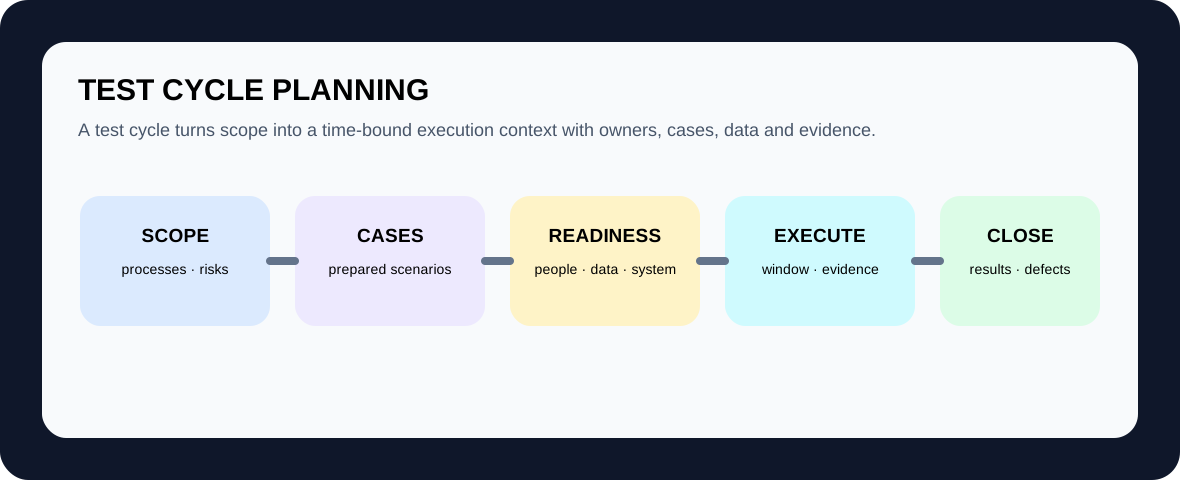
Test cycles are planned by defining what must be tested in a particular execution window, which prepared test cases belong in that cycle, who will execute them, what systems and data must be ready, how results and evidence will be captured, and what happens to failed tests. In SAP Cloud ALM, test plans group test cases into specific test cycles and give each assigned occurrence its own execution context.
Start with the purpose of the cycle
A project can have several testing iterations because different decisions need evidence at different points. One cycle may validate a focused configuration increment; another may cover cross-process integration; another may repeat critical scenarios after fixes or before a release. The planning question is not simply “when do we test?” but “what decision should this cycle make possible?”
Turn scope into executable test cases
SAP Cloud ALM allows test cases to be related to requirements, user stories, process hierarchy nodes, solution activities, interfaces and applications. That traceability helps the team check whether the selected cases represent the intended business scope. Test cases should also be prepared before execution, with actions and expected results clear enough for testers to recognize a pass, a failure or a test-case problem.
Readiness determines whether the calendar is realistic
A scheduled window is useful only when the prerequisites are available. Confirm that the required test cases are prepared, testers are assigned, the system or tenant is ready, representative data exists, interfaces and dependent applications are available, and known blocking defects are understood. In SAP Cloud ALM, a test case assigned to a test plan becomes available under that plan for execution when the plan is in the appropriate testing status.
Plan execution and retesting as one cycle
Execution should leave enough time not only to run the first attempt, but also to investigate failures, correct genuine defects, update an incorrect test case when necessary, and retest. SAP Cloud ALM supports detailed test-action statuses, defects and evidence. A failed result therefore becomes part of the cycle’s control loop rather than merely a red number on a dashboard.
Use separate cycles when the execution context is genuinely different
SAP Cloud ALM test plans are designed for repeated or parallel testing contexts. The same test case can be assigned to multiple test plans, producing separate test occurrences with independent execution contexts. This is useful when similar scenarios must be run for different phases, rollouts, organizations or execution windows without mixing their results.
Continue with How End-to-End Scenarios Are Selected, How Negative Test Cases Are Designed, How Regression Testing Works and the Consulting & ERP Projects hub.