
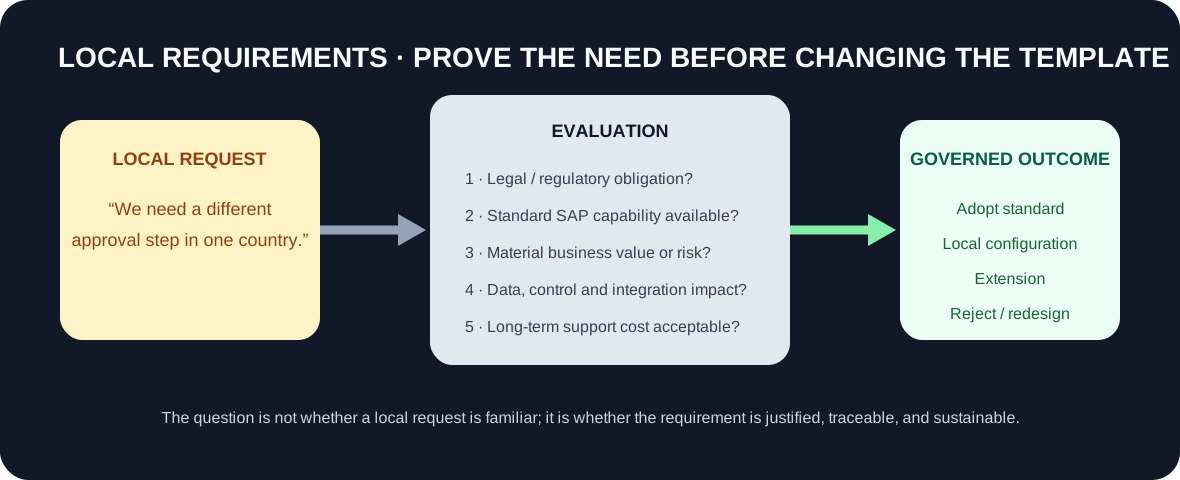
ERP teams evaluate a local requirement by clarifying the business or legal outcome, testing whether the global template or standard solution already satisfies it, and then assessing the consequences of any deviation. Mandatory legal or regulatory needs receive different weight from preferences. If a gap remains, governance decides whether to adopt the standard, configure a permitted variation, extend the solution, change the process, or reject the request.
Why local requirements need a formal evaluation
A global ERP program is usually trying to standardize processes, data, controls, and technology across entities. Local organizations, however, operate under different laws, tax regimes, languages, market practices, customer expectations, and legacy habits. Some differences are genuinely mandatory; others are historical preferences.
SAP's Fit-to-Standard approach is designed around validating standard processes and identifying delta requirements. SAP also frames clean-core extensibility around keeping custom extensions decoupled from the core where possible. Together, those principles support a disciplined question: what outcome is required, and what is the least disruptive way to achieve it?
Step 1: separate the requirement from the requested solution
“We need a custom field” is a proposed solution. The requirement might actually be “the invoice must display a statutory registration identifier.” Those are different statements. Separating them gives the team freedom to discover whether the identifier already exists, can be derived, belongs in master data, or can be supported through standard output configuration.
Step 2: classify why the local difference exists
Useful categories include legal or regulatory obligations, tax and statutory reporting, language or localization needs, market/customer commitments, operational constraints, control requirements, and local preferences. Classification matters because the evidence and decision authority differ. A documented legal requirement should not be treated like “this is how our old system worked.”
Step 3: test the global standard
The team checks whether the requirement is already satisfied by the global process, country localization, standard configuration, master data, reporting, or another approved capability. This is closely related to Fit-to-Standard and the broader process used when global template decisions are made.
Step 4: assess the cost of deviation
A local deviation is not only a build estimate. It can affect data harmonization, controls, testing, interfaces, support, training, analytics, upgrades, rollout reuse, and future cloud releases. A small local customization can create a permanent branch in the operating model. The decision should therefore consider lifecycle cost and governance, not just immediate effort.
Step 5: make the decision through the right governance
Material deviations usually require a design authority, process owner, architecture body, or equivalent governance forum. The decision record should capture the requirement, evidence, options considered, impacts, owner, decision, and any conditions. This prevents the same question from being reopened in every rollout wave.
Examples of different outcomes
- Mandatory statutory output: adopt an available country localization or approved extension when the legal need is proven.
- Legacy preference: adopt the global standard when no material business or legal outcome would be lost.
- Customer-specific operational need: assess whether standard configuration or master data can satisfy it before considering extension.
- Control concern: confirm the actual control objective and evaluate process, authorization, workflow, and reporting options rather than assuming customization is required.
Consultant thinking: challenge the solution without dismissing the need
A good consultant does not say “global template says no” before understanding the requirement. Equally, they do not accept “local business needs it” as sufficient evidence. The professional stance is curious and disciplined: establish the outcome, prove the constraint, compare alternatives, quantify consequences, and route the decision through agreed governance.
This is also why rollout sequencing matters. A decision made for one country may affect later deployments, so teams should connect local evaluation with rollout strategy and template governance.
Key takeaway
Local requirements are evaluated by evidence, fit, impact, and governance. The goal is not zero localization; it is justified localization—meeting real local obligations without fragmenting the global ERP model unnecessarily.