
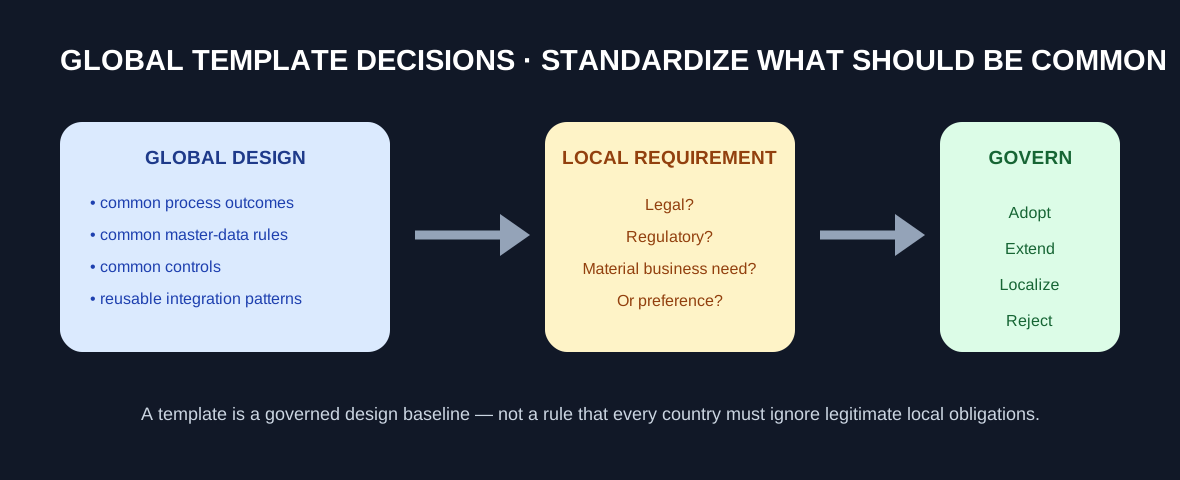
Global template decisions are made by defining which process outcomes, data rules, controls, roles, integrations, and solution patterns should be common across the enterprise, then evaluating local requirements against that baseline. Governance decides whether each difference should adopt the template, be handled through approved localization or extension, or justify a controlled exception. The decision should consider legal necessity, business value, risk, operating-model consistency, implementation cost, maintainability, and future rollout impact.
Why organizations create a global template
Without a common baseline, every country or business unit can redesign the same process independently. That increases variation in master data, controls, interfaces, reporting, support, and future upgrades. A template reduces unnecessary divergence and gives later rollout waves a starting point that has already been designed and tested.
But standardization is not an end in itself. A tax requirement, statutory reporting obligation, local payment instrument, labor rule, or material market difference can require localization. The governance challenge is separating genuine requirements from historical preference.
What usually belongs in the template
A template can cover process design, organizational principles, master-data standards, approval and control patterns, reporting definitions, role concepts, integration patterns, and configuration baselines. The exact boundary depends on the transformation. Some programs standardize heavily; others deliberately allow more local autonomy.
The template should also define what is not globally fixed. Without that boundary, local teams cannot tell whether they are making an allowed choice or creating an exception.
How a local difference is evaluated
Start by describing the business outcome rather than the requested system change. Then ask whether the template already achieves that outcome. If not, classify the reason for difference. Legal and regulatory requirements carry different weight from a preference to preserve an old screen or approval path. Next assess whether a solution can satisfy the requirement without breaking the common design.
Who should make the decision
Decision rights should be explicit. Global process owners usually protect the end-to-end process and enterprise standard. Local process experts explain statutory and operational needs. Architecture and solution leads assess technical consequences. Security, controls, data, integration, and change teams contribute where the decision affects their domains. A design authority or equivalent governance forum resolves material exceptions and records the rationale.
Connection with rollout strategy
The template and the rollout strategy shape each other. Early waves test whether the template works across real operating contexts. Later waves should benefit from what was learned, but they should not silently accumulate exceptions. When a local need reveals a genuinely better enterprise design, the governance question may be whether to improve the global template for everyone rather than create a one-country deviation.
Controls that prevent template erosion
- Document the global design principles and allowed local choice points.
- Require a business rationale and owner for exceptions.
- Separate statutory needs from historical preference.
- Assess cross-process, data, integration, reporting, security, and support impacts.
- Record decisions so later rollout waves do not reopen settled questions without new evidence.
- Review whether repeated exceptions indicate a weak template rather than difficult countries.
Consultant thinking: protect the outcome, not the artifact
Teams sometimes defend a template because “headquarters approved it,” while local teams defend a legacy process because “we have always done it this way.” Neither is sufficient. Consultants should bring the discussion back to outcomes, controls, obligations, enterprise complexity, and long-term maintainability. The best decision may be adoption, localization, or a change to the global template itself.
Key takeaway
Global template decisions are governance decisions about where enterprise consistency creates value and where local difference is justified. Strong programs make those decisions with explicit criteria, evidence, ownership, and lifecycle consequences in view.