
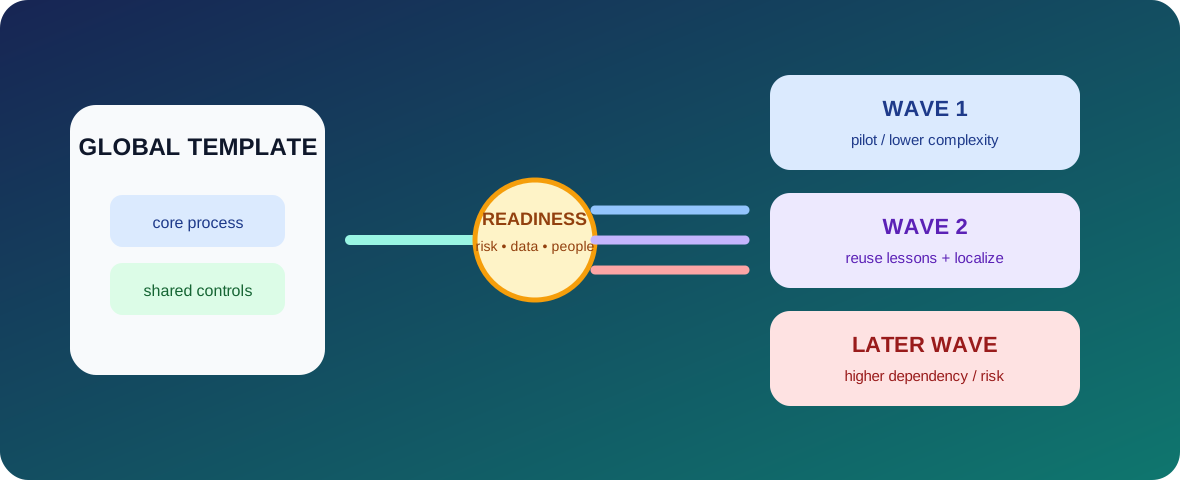
An ERP rollout strategy is selected by comparing deployment options—such as a single big-bang go-live, phased deployment, pilot-first rollout or repeated waves—against business criticality, process and data dependencies, integration constraints, readiness, cutover complexity, support capacity and value timing. The best sequence is not automatically the fastest one; it is the sequence that makes the transformation executable while preserving the required end-to-end business outcomes.
Rollout strategy is more than a go-live date
Large ERP transformations often span countries, legal entities, plants, business units or process groups. Teams must decide whether these populations move together or in a sequence. That decision changes the project architecture: interfaces may need temporary coexistence, master data may cross old and new systems, reporting may span mixed landscapes, and support teams may need to stabilize one wave while preparing the next.
The rollout model therefore belongs in scope and solution discussions early. It influences estimates, testing, migration, cutover, change management and the period for which legacy systems must remain operational.
Common rollout patterns
Big bang: the defined population moves at one coordinated go-live. This can shorten coexistence but concentrates cutover, readiness and stabilization risk.
Phased by geography or organizational unit: countries, companies, plants or business units move in sequence. This can create learning opportunities but requires a deliberate coexistence architecture while some units remain on the legacy environment.
Phased by process or capability: selected processes or solution components are deployed at different times. This can be appropriate when boundaries are genuinely separable, but tightly integrated processes can make artificial process splits expensive.
Pilot then waves: a representative or strategically chosen first population proves the template and operating model before repeated rollout waves. A pilot should be chosen for learning value, not simply because it is the smallest site.
The criteria that shape the sequence
- Business criticality: what is the operational consequence if the first deployment is unstable?
- End-to-end dependencies: which units trade, manufacture, procure, sell or report together and therefore cannot be split casually?
- Data dependencies: which master and transactional data must remain consistent across waves?
- Integration: how will old and new systems exchange transactions during coexistence?
- Legal and reporting boundaries: do statutory, tax, fiscal-year or consolidation requirements constrain timing?
- Readiness: are local process owners, data teams, testers, trainers and support resources actually ready?
- Change capacity: how much simultaneous organizational change can each population absorb?
- Support capacity: can the program stabilize one wave while preparing the next without exhausting key specialists?
The rollout discussion builds directly on implementation scope and organizational change scope. It also changes data migration scope because each wave may require its own extraction, validation and cutover events.
Why the first wave matters
The first wave establishes more than technical proof. It tests the template, data ownership, cutover playbook, training model, hypercare process and the program's ability to turn local feedback into controlled improvement. A first wave that is too simple may teach little; one that is too complex may expose the program to unnecessary risk.
Teams should explicitly define what must be learned before wave two and which changes are permitted to the template. Otherwise each rollout can become a new design project, undermining the benefits of standardization.
Consultant thinking: sequence around business relationships
One of the most common planning mistakes is sequencing only by organizational chart. ERP processes cross those boundaries. A selling company may depend on a manufacturing plant, a shared-service center may process invoices for multiple entities, and a central warehouse may serve several countries. Splitting strongly coupled units into different waves can create complex temporary interfaces and manual workarounds.
The better question is: which populations can operate coherently together during the transition? That requires input from process, integration, data, finance, operations and change teams—not only project scheduling.
Key takeaway
Rollout strategy is a deliberate trade-off among speed, coexistence complexity, operational risk, readiness and learning. The strongest strategy preserves end-to-end business integrity, gives the organization enough capacity to absorb change and creates useful learning without turning every wave into a redesign.