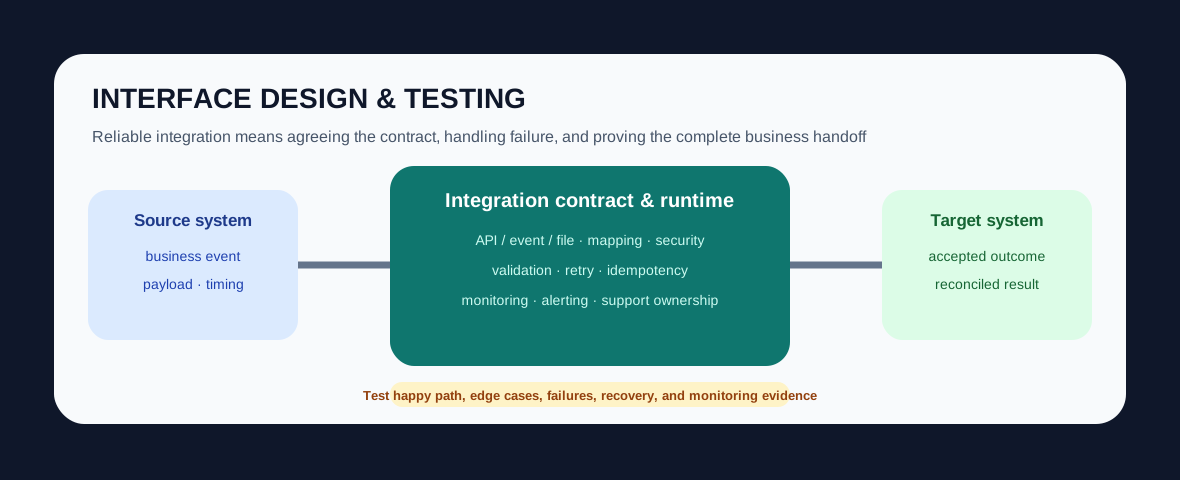
SAP interfaces are designed by first defining the business handoff: what event triggers integration, which system owns the data, what information must cross the boundary, when it must arrive, and what should happen if processing fails. The technical team then chooses an appropriate supported integration mechanism and defines message/API contracts, mappings, security, monitoring and error handling. Testing proves both technical exchange and end-to-end business outcomes, including negative cases, duplicates, retries and recovery.
Start with the business event, not the middleware
Integration discussions often become technical too early. Before choosing an API, event, IDoc, file or middleware flow, teams should understand the process boundary. For example: a customer order is created externally and must enter SAP; a supplier update must leave SAP; a goods movement must notify another platform; or an approved employee record must synchronize with a downstream system.
The design needs a clear source of truth, trigger, frequency, latency expectation, volume, required fields and ownership. These are business decisions as much as technical ones.
Define the integration contract
A useful interface specification describes what both sides promise. It normally includes message or API structure, mandatory and optional data, code/value mappings, units, dates and time zones, identifiers, sequencing, validation rules and expected responses.
Ownership is crucial. If a customer number is invalid, which system corrects it? If a message is sent twice, should the target reject the duplicate or process idempotently? If a downstream system is unavailable, who monitors the queue and who owns business follow-up? These questions determine whether an interface is operable after go-live.
Choose the pattern deliberately
SAP Integration Suite documentation covers capabilities for cloud integration, APIs and event-driven integration. SAP S/4HANA also exposes supported APIs and integration scenarios through published content. The implementation pattern should match the business need rather than forcing every handoff through one technology.
Synchronous APIs may fit immediate request/response interactions. Asynchronous messages or events can decouple systems when immediate response is unnecessary. Batch or file-based integration can still be appropriate for some scheduled exchanges. The architecture should account for supported interfaces, clean-core principles, security, throughput and operational monitoring.
Design failure behavior before testing it
Interfaces fail in ordinary ways: a required value is missing, authentication expires, a code mapping is unknown, a target is unavailable, messages arrive out of order, or a retry creates a duplicate. A design that documents only the happy path is incomplete.
Define which failures are technical and which are business errors, how they are logged, whether retries are automatic, where failed messages are held, how corrections are resubmitted, and how operations teams know that intervention is required.
Test in layers
Technical unit or component tests confirm mappings, transformations, endpoints and error branches. Integration tests prove the source, middleware and target can exchange data together. End-to-end business tests prove that the interface produces the correct business consequence — for example, the expected SAP document, status or downstream action.
Testing scope should include high-risk variants, not just the easiest message. Negative tests are important because production interfaces spend much of their operational life handling exceptions.
Test data and reconciliation matter
Teams need representative data: valid master data, missing values, boundary values, code mappings, multiple currencies or units where relevant, and records that exercise different business rules. Sensitive production data should not be copied casually into test environments.
For high-volume or financially relevant interfaces, reconciliation is part of acceptance. Teams may compare sent versus received counts, control totals, document values or status acknowledgements so silent data loss is detectable.
Security and authorization are part of interface behavior
Credentials, certificates, OAuth flows, roles and network connectivity should be tested under the intended production-like security model. A successful integration that depends on an overprivileged technical user is not a good production design.
Access should follow least-privilege principles, secrets should be managed appropriately, and logs should provide enough information to diagnose failures without exposing sensitive data unnecessarily.
Operational readiness closes the design
Before go-live, identify who monitors the integration, which alerts matter, how support teams locate a failed message, who can correct data, what can be retried safely, and when an incident should be escalated. The interface should have an owner on both the technology and business sides.
This connects back to integration architecture discussions with business teams: failure impact and ownership are architectural requirements, not post-go-live details.
Consultant thinking: test the handoff, not just the pipe
An interface can be technically green while the business process is wrong. The strongest test asks whether the originating event, transferred data, target behavior, accounting or operational consequence, acknowledgement and recovery all make sense together. That is why functional consultants, integration specialists and business users share responsibility for acceptance.
Key takeaway
Good interface design makes the business contract explicit: trigger, ownership, data, timing, security and failure behavior. Good interface testing proves the contract under normal, negative and recovery conditions. The objective is a dependable business handoff that operations can monitor and support, not merely a successful message transmission.