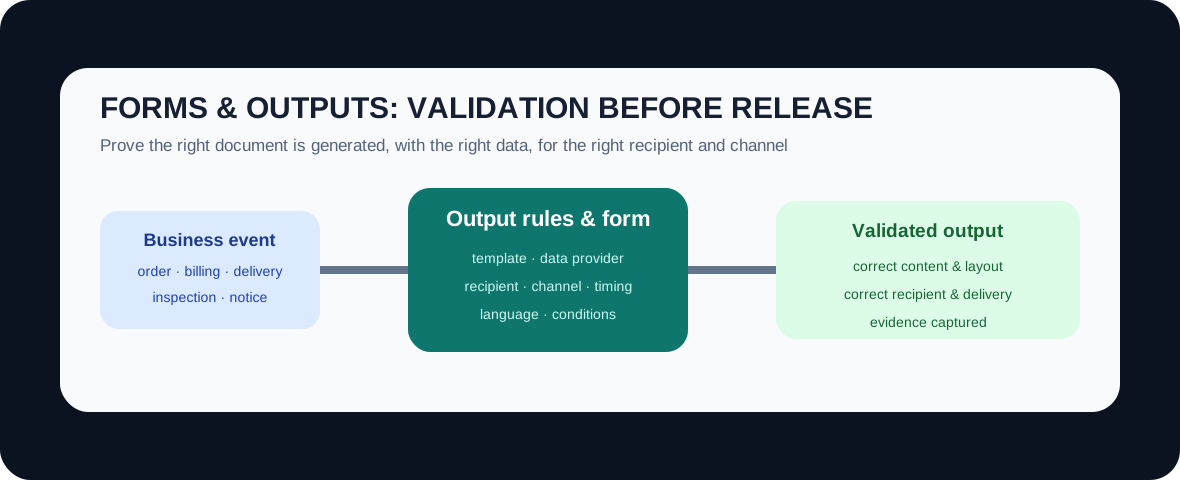
ERP forms and outputs are validated by testing the complete output transaction: the triggering business event, output determination, data selection, legal and business content, language, layout, recipient, delivery channel, repeat/reprint behavior, exceptions and evidence. A purchase order, invoice, delivery note, payment advice or label may render perfectly and still be wrong if it contains incorrect values, is sent to the wrong partner, triggers at the wrong status or fails for a realistic data combination. Validation therefore combines functional testing, content review and rendered-document inspection.
Start with the purpose of the output
Every output exists for a reason. A purchase order communicates a commitment to a supplier. An invoice communicates a financial claim to a customer. A delivery document supports fulfillment. A payment advice explains settlement. A warehouse label supports physical identification.
The first validation question is therefore not “Does the logo align?” It is “What business decision or communication must this output support?” From that purpose, the team can define required fields, conditions, recipients, timing and acceptance criteria.
Validate triggering and output determination
The team first proves when the output should and should not be created. That may depend on document type, status, partner, organization, channel, language or other business rules. In SAP S/4HANA, Output Management can use rule-based determination to decide parameters such as output type, recipient and channel in supported applications.
Negative tests matter here. If an invoice should be sent only after a particular status, test the status before and after the condition is satisfied. If a supplier is configured for electronic output rather than print, verify that the correct channel is selected.
Validate business data and calculations
Every displayed value should be traced to an agreed source or calculation. Typical checks include organization details, business-partner name and address, document number and date, item descriptions, quantities, prices, taxes, currencies, payment terms, bank information, totals and legally required text.
Do not validate only one “clean” example. Include long names, multiple items, discounts, different currencies, alternative addresses, optional fields, page breaks, zero values where valid and other realistic combinations. This exposes mapping and layout problems that a simple sample hides.
Validate layout as a usability requirement
Layout matters because the recipient must be able to understand and use the document. Check page headers and footers, column alignment, wrapping, page numbering, totals, signatures where applicable, barcode or label readability, and whether critical text is clipped or separated from its context.
For forms with multiple languages or scripts, test the actual fonts and text expansion. A layout that works in one language may overflow in another.
Validate recipient and delivery channel
A correct document sent to the wrong person is a serious defect. Test partner and recipient determination, email addresses or electronic destinations, print parameters and fallback behavior. Where the process supports repeat output or reprinting, verify whether duplicates are marked, controlled or logged as required by the business.
Also test failure handling. What happens if an email address is missing? Is the output held, retried, routed elsewhere or visible in an error monitor? The expected behavior should be explicit.
Connect output testing to end-to-end testing
Forms and outputs should not be tested only by the developer or form specialist. They belong in the relevant business scenario. A purchase-order output should be validated as part of procurement. An invoice should be validated in the order-to-cash scenario. A payment advice belongs with payment processing.
This connects naturally to interface testing and the broader testing scope. The output may also depend on custom development governed through custom-development requests.
What good test evidence looks like
Evidence should identify the scenario, source document, expected output rule, actual result and reviewer. Keep the rendered form or output where appropriate, but also record the functional assertions: why it triggered, which recipient was selected, which channel was used, and which values were reconciled.
When a defect is fixed, retest the failed scenario and relevant regression scenarios. A change to a shared form template, determination rule or data mapping can affect more documents than the one that exposed the original issue.
Consultant thinking: validate communication, not just code
A form is a business communication produced by the ERP process. Ask what the recipient needs to know, what the company is committing to, what legal or commercial information must be correct, and what operational action follows from the document.
That mindset turns output validation from pixel checking into process assurance. The visual layout still matters, but only as one part of a complete and controlled communication transaction.
Key takeaway
Forms and outputs are validated end to end: trigger, content, calculations, recipient, channel, rendering, exceptions and evidence. A successful test proves that the right business event produces the right communication for the right recipient—not merely that a template can generate a PDF.