
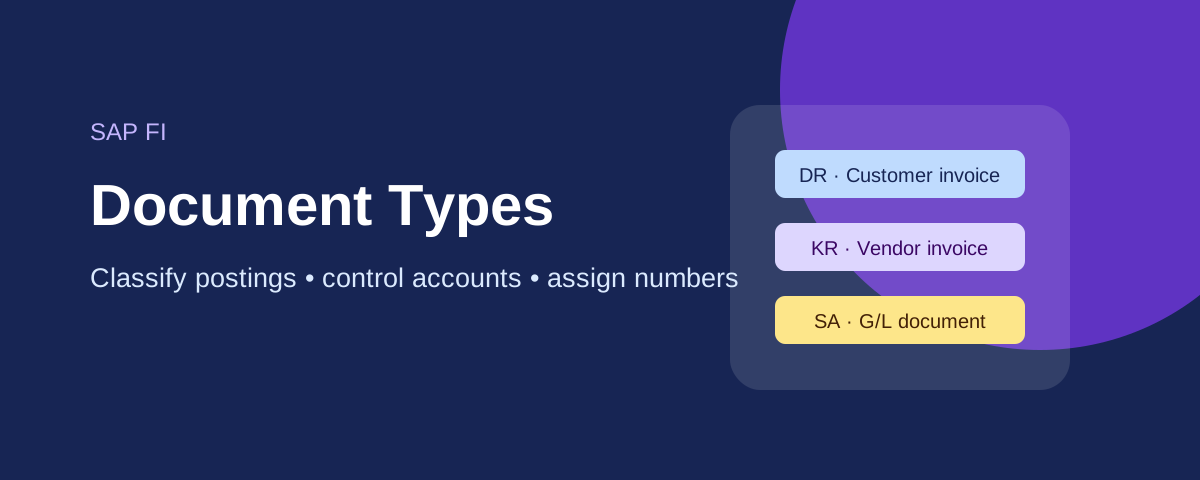
In SAP Financial Accounting, a document type is a header-level key used to classify accounting documents and distinguish business transactions. SAP documentation says it can control which account types may be posted and which document-number range is used. Standard examples include DR for customer invoice, KR for vendor invoice and SA for general G/L postings.
Why SAP needs document types
An accounting system receives many kinds of postings: customer invoices, supplier invoices, incoming payments, outgoing payments, adjustments and general-ledger entries. If all of them were treated as one undifferentiated stream, it would be harder to control posting behavior, investigate documents or structure number assignment.
The document type gives a posting an immediate accounting identity. Because it belongs to the header, it applies to the complete accounting document rather than to only one line item.
Three jobs a document type performs
| Function | Why it matters |
|---|---|
| Classify the business transaction | Helps users recognize the nature of a document when displaying or evaluating postings. |
| Control account types | Restricts which account categories, such as customer, supplier/vendor or G/L accounts, are permitted. |
| Assign document numbers | Connects the document type to a number range so accounting documents receive numbers under the intended interval. |
Common standard examples
SAP lists standard document types including DR for customer invoices, DZ for customer payments, KR for vendor invoices, KZ for vendor payments, KG for vendor credit memos and SA for general G/L account documents. Exact usage can be adapted in a customer's system, so consultants should inspect the configured environment instead of assuming every organization uses standard types unchanged.
Do not memorize codes without understanding controls.
The valuable question is not only “What does KR mean?” but “Why does this transaction need its own document type, what accounts may it touch, and which numbering/control requirement does that support?”
Document type is not the same as posting key
Beginners often mix these concepts. The document type is stored in the document header and classifies the whole accounting document. Posting keys operate at line-item level and influence debit/credit behavior and account-type usage for individual lines. Both matter, but at different structural levels.
How document types connect to number ranges
SAP documentation states that a number range is assigned to every document type. This makes document numbering part of accounting-document control. The practical implication is that changing document-type design can affect how postings are grouped and traced; it should not be treated as cosmetic configuration.
A practical troubleshooting example
Imagine a user is trying to post a supplier invoice but receives an account-type restriction. One useful check is whether the selected or defaulted document type permits the required account categories. This is why document types matter in real support and implementation work: they sit between business intent and system posting rules.