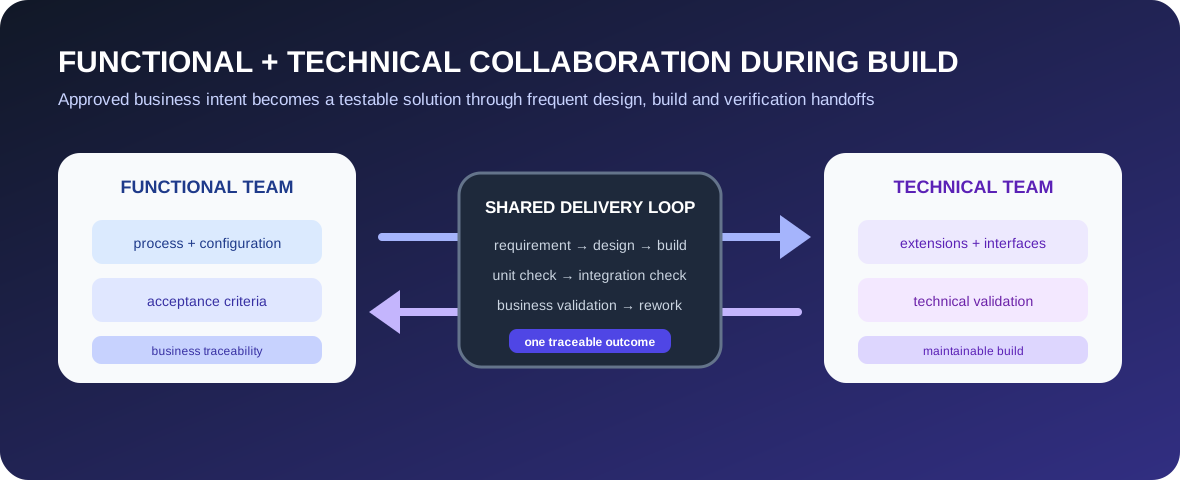
During SAP build, functional teams translate business requirements into process behavior, configuration and testable acceptance criteria, while technical teams design and build developments, integrations, forms, extensions or other technical components. Effective collaboration is iterative: both sides clarify assumptions, review designs, test increments, resolve defects and manage dependencies until the combined solution satisfies the approved requirement.
The boundary is real, but it is not a wall
Functional consultants usually own more of the process interpretation: what the business needs, which standard capability applies, how configuration should behave, what data and controls matter, and what outcome users should see. Technical specialists own the engineering choices required when code, interfaces, extensions, forms, APIs or platform services are needed.
The work overlaps at the design boundary. A functional requirement can be impossible, risky or unnecessarily complex if technical constraints are discovered too late. A technically elegant solution can still fail if it does not match the business process. That is why build collaboration starts before coding.
Specifications are conversation anchors
A functional specification or equivalent backlog item should make the requirement testable: business context, trigger, inputs, rules, expected outputs, exceptions, authorization considerations, data dependencies and acceptance criteria. It should not pretend to answer technical design questions that belong with the developer or architect.
The technical design then explains how the requirement will be implemented: components, interfaces, data structures, APIs, extension points, error handling and other engineering decisions. In iterative delivery, these may be maintained as backlog details rather than heavyweight documents, but the need for shared understanding remains.
Collaboration repeats through the build cycle
Where collaboration matters most
- Integrations: functional teams define business events and expected process outcomes; technical teams define interfaces, mappings, protocols, retries and monitoring.
- Extensions: both sides must challenge whether the requirement justifies custom behavior and whether a released extension approach can satisfy it.
- Forms and outputs: business content, legal needs and recipient logic meet technical templates, data retrieval and output services.
- Conversions and data: functional ownership of meaning and validation must connect with technical extraction, transformation and load logic.
- Defects: teams need to distinguish configuration, code, data, authorization, integration and test-data causes before assigning a fix.
Clean-core thinking changes the conversation
SAP's clean-core guidance emphasizes using standard capabilities and upgrade-stable extensibility approaches where possible. During build, this means a functional request for “customization” should trigger a joint design question: can the outcome be met through standard process, configuration, in-app extensibility, side-by-side extension or another supported pattern with lower lifecycle cost?
This connects directly with how configuration work is organized. Configuration and development may be separate work items, but they belong to the same approved solution design and must meet in integrated testing.
What weak collaboration looks like
Warning signs include specifications with ambiguous acceptance criteria, developers discovering key business rules after coding starts, functional teams testing only happy paths, technical teams making business decisions without confirmation, and defects bouncing between teams because nobody owns end-to-end diagnosis.
These problems are usually coordination failures rather than evidence that one discipline is more important. A good delivery model makes ownership clear while keeping shared dependencies visible.
Consultant thinking: bring examples, not labels
Instead of saying “the interface is wrong,” show the business event, input, expected result, actual result and evidence. Instead of saying “the requirement is unclear,” identify the exact unresolved rule. Specific examples let functional and technical specialists solve the same problem rather than defend their own workstream.
Key takeaway
Functional and technical collaboration during SAP build is an iterative design-and-verification partnership. Functional teams protect business intent; technical teams protect engineering quality; both are responsible for proving that the combined solution works through realistic end-to-end scenarios.