
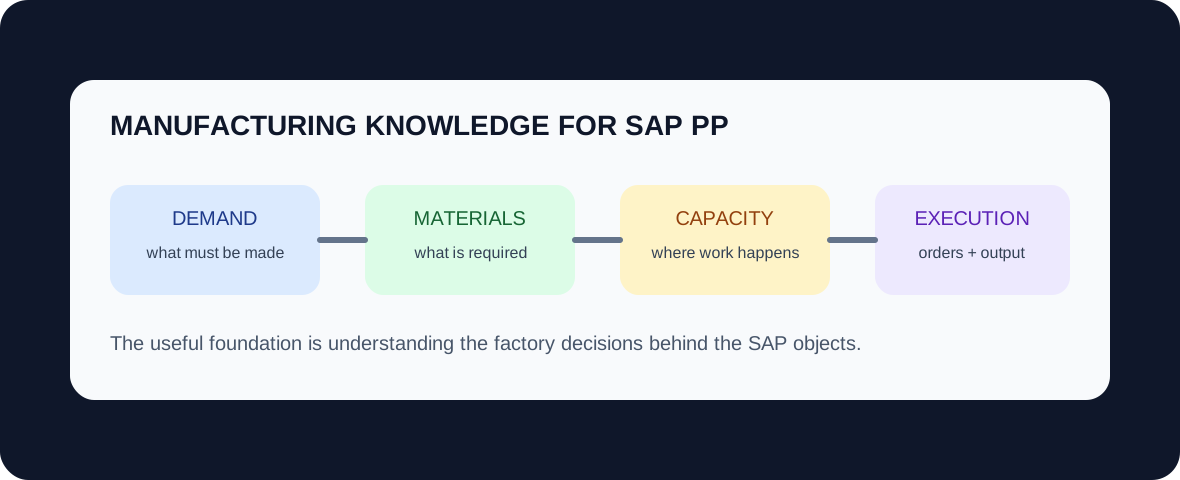
For entry-level SAP PP, practical manufacturing knowledge matters more than deep engineering expertise. You should understand what a bill of material represents, why routings and work centers exist, how demand becomes planned supply, how material availability and capacity affect production, and how production orders move through release, issue, confirmation and receipt.
Start with the manufacturing story
Production planning answers a sequence of business questions: what must be produced, by when, using which components, on which resources, in what quantity and with what constraints. SAP objects such as materials, BOMs, routings, work centers, planned orders and production orders encode those decisions.
SAP Help describes production planning as part of a broader planning and manufacturing process in which planning results lead into manufacturing-order execution. The important beginner insight is that planning and execution are connected: a plan is useful only if materials, capacity and shop-floor execution can support it.
The minimum concepts worth knowing
Understand the difference between a finished product and its components; a BOM as the component structure; a routing as the operations needed to make something; and a work center as the place or resource where work is performed. Learn why production versions connect valid production alternatives, and why MRP calculates proposals from demand and available supply.
Then understand the execution side: planned orders may become production orders; orders are released; components are issued; operations are confirmed; yield or scrap is recorded; and finished output is received into stock. You do not need to configure every option to understand this lifecycle.
What you do not need on day one
You do not need advanced industrial engineering, detailed scheduling expertise, every planning strategy, or every make-to-order and repetitive-manufacturing variation before starting. First learn the normal flow and the vocabulary used by planners, production supervisors, stores, quality teams and cost accountants.
How to test your readiness
Take a simple product and explain, without SAP screens, what must be known before production can start: required quantity, due date, component list, operation sequence, resource availability and expected output. Then explain what changes when a component is short or a work center is overloaded. If you can reason through those consequences, you have the right foundation.
What to learn next
Move into SAP PP learning, then connect planning with procurement, inventory, quality and controlling. A useful adjacent article is how much procurement knowledge is needed for SAP MM.