
SAP PP: (Production Planning)
The Production Planning (PP) module facilitates production scheduling aligned with business demand and capacity. It creates schedules for production and procurement, ensuring raw materials meet production needs. Eligibility includes graduates or postgraduates, freshers in production/production departments, logistics analysts, consultants, or professionals experienced in production planning and control.
SAP PP: (Production Planning)

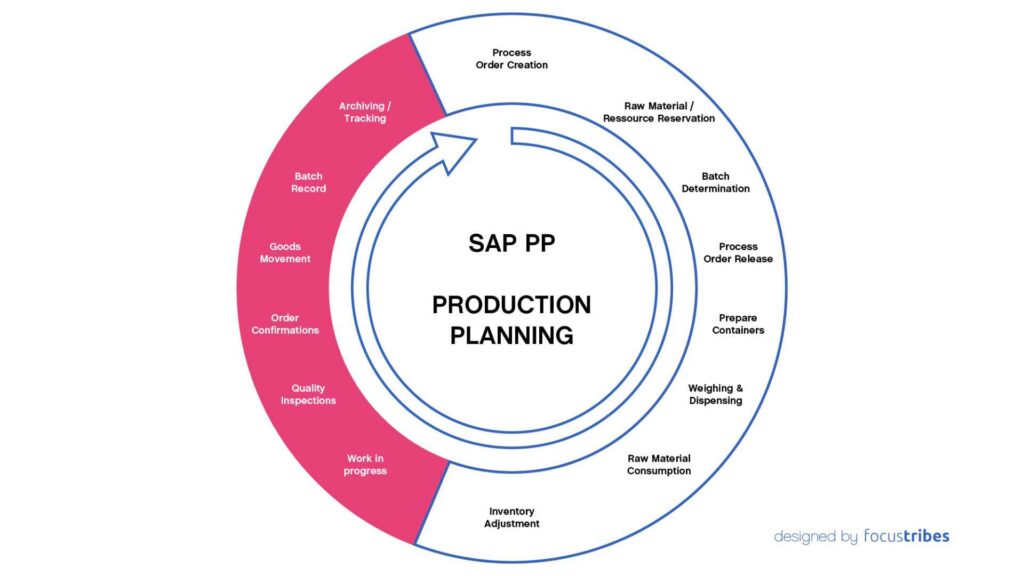
SAP Production Planning process:
Overall, these elements collectively contribute to the effective coordination, control, and optimization of the production process, ensuring that the final products not only meet quality standards but also align with customer requirements.
1.
Planning of Records & Schedules
This involves the systematic organization and creation of records and schedules related to production activities. It ensures that there is a structured plan in place to guide and monitor the manufacturing processes.
2.
Repetitive Manufacturing
This refers to the production of goods in a repetitive or continuous manner, often applicable to standardized products. It involves the efficient and consistent manufacturing of identical or similar items.
3.
Production – Process Industries
This aspect addresses the specific requirements and nuances associated with production in process industries. Process industries typically involve continuous processes such as chemical manufacturing or food processing.
4.
Dispatching Inspection
Dispatching involves the timely and organized release of products or materials. Inspection in this context refers to the assessment and verification of the quality of the dispatched items before they reach the customer or next stage in the supply chain.
5.
Co-ordination and Control of Raw Materials, Representative, and Tools
This encompasses the coordination and control of essential elements in the production process. It involves managing the availability and use of raw materials, representatives (possibly referring to samples or prototypes), and tools. The goal is to achieve high-quality products while meeting customer demands.

Summary
In summary, SAP ABAP is a versatile and powerful programming language tailored for SAP’s business applications. Its rich set of features and tools make it a key component for developing, customizing, and extending SAP solutions to meet the diverse needs of businesses

The Brief
Vestibulum posuere pharetra massa, in scelerisque orci pulvinar in. Suspendisse tristique vehicula ante. Nam consequat nibh justo, non sollicitudin sem placerat vitae. Praesent dignissim sem a auctor scelerisque. Duis placerat dui ac tortor tincidunt, pulvinar condimentum ex euismod. Vivamus ultrices vitae tortor ut rutrum. Integer sed pharetra neque, ut commodo tortor. Maecenas vehicula semper tortor, ut auctor diam ornare ut. Pellentesque et ex et dolor tempor suscipit. Phasellus vel orci vel orci tincidunt interdum. Nunc quis viverra metus. In cursus tempor purus et tincidunt.
Maecenas vehicula semper tortor, ut auctor diam ornare ut. Pellentesque et ex et dolor tempor suscipit. Phasellus vel orci vel orci tincidunt interdum. Nunc quis viverra metus. In cursus tempor purus et tincidunt.
- Vestibulum et ultrices posuere cubilia
- Curabitur aliquam dolor at bibendum
- Etiam id quam tempus justo at posuere est
- +150 dolor lacinia tempor orci
What is SAP FI ?
SAP FICO (Financial Accounting and Controlling) is a key module in SAP ERP, managing financial data and enabling the creation of statements like Balance Sheets and Profit/Loss for external reporting.
Integrated with modules like SAP MM, SAP PS, and others, SAP FICO streamlines financial management systems. Aspire Techsoft offers comprehensive SAP FICO Course Training in Pune, facilitating career opportunities in accounting and finance.
Completion of the course enhances job prospects, especially in large MNCs, with SAP FICO consultants sought after for effective financial management and planning, offering lucrative salary potential.
- Vestibulum et ultrices posuere cubilia
- Curabitur aliquam dolor at bibendum
- Etiam id quam tempus justo at posuere est
- +150 dolor lacinia tempor orci




The Results
Morbi malesuada, felis eget aliquam hendrerit, felis ex tincidunt mi, gravida facilisis leo nisi nec tellus. Aenean lobortis blandit turpis, sed sollicitudin metus auctor ac. Fusce lacinia interdum metus. Pellentesque et quam nisi. Sed fringilla gravida lorem, id rhoncus justo egestas sed.
Curabitur pharetra commodo enim, id cursus neque dapibus sed. Curabitur pellentesque faucibus purus, non finibus turpis pretium non. Donec tempor lectus sed tincidunt sodales. Proin lobortis, nibh eget tincidunt placerat, elit sem luctus est, sed cursus enim mauris vel odio.
9.5%
Decrease in bounce rate
22.5%
Increase in average session duration
130%
More page views

Pellentesque et quam nisi. Sed fringilla gravida lorem, id rhoncus justo egestas sed. Nulla sagittis vel ante sit amet tempor. In sit amet neque non tellus interdum tincidunt eget eu odio. Awesome!
- Miriam Doe, CEO of Seven Arts
SAP Production Planning Sub Modules?
Each of these concepts plays a specific role in the broader context of production and supply chain management, contributing to the overall efficiency and effectiveness of manufacturing processes.
1.
Production Planning
Production Planning: The process of aligning production schedules with demand and available resources to optimize manufacturing efficiency.
2.
Sales and Operations Planning (S&OP)
Integration of sales and operational activities to develop plans that meet customer demand while aligning with business objectives.
3.
Long-Term Planning
Strategic planning that involves making decisions for the organization’s future, often considering several years ahead.
4.
CRP – Capacity Requirement Planning
A system that calculates the capacity needed for production based on the production plan.
5.
Material Forecast
Estimating future material requirements to ensure a smooth production process.
6.
Master Production Scheduling (MPS)
Detailed plan specifying when and how much of each product will be produced in a specific time frame.
7.
DRP – Distributed Resource Planning
Planning and managing resources across multiple locations or facilities.
8.
DEM – Demand Management
The process of forecasting, planning, and managing customer demand for products or services.
9.
SFC – Application Component Production Orders
Shop Floor Control – Managing and controlling production activities on the shop floor.
10.
KANBAN
A lean manufacturing technique that uses visual cues to signal the need for the next production or replenishment step.
11.
Repetitive Manufacturing
Producing the same or similar products in a continuous or repetitive manner.
12.
Assembly-to-Order
A production strategy where products are assembled based on customer orders, allowing for customization.
Who can learn SAP Production Planning Course:
- SAP PP/QM/MM Consultants or Managers or End Users: Professionals specializing in SAP consulting, management, or end-user roles for production, quality, and materials.
- Freshers with Production/Manufacturing Department Users: Entry-level individuals with a focus on production or manufacturing roles.
- Logistics Analysts & Consultants: Professionals involved in logistics analysis and consulting.
- Business Analysts & Consultants: Individuals specializing in business analysis and consulting.
- SAP PP End Users: Individuals using SAP for Production Planning functions.
- SAP Professionals: Overall professionals experienced in SAP systems.
- Production or Procurement Planners: Individuals responsible for planning production or procurement processes.
- SAP Career Aspirants & Beginners: Individuals aspiring to pursue a career in SAP or new to the field.
- Anyone Interested in SAP Production Planning Functionality: Enthusiasts keen on understanding and utilizing SAP’s Production Planning features.
- SAP Functional Consultants: Consultants specializing in SAP functional areas.
- Project Team Members: Members involved in SAP implementation or enhancement projects.
- Project Managers: Managers overseeing SAP projects.
- Production Supervisors: Professionals supervising production processes.
- Factory Managers: Managers responsible for overall factory operations.
- Supply Chain Professionals: Professionals involved in supply chain management.
- Business Analysts: Professionals specializing in business analysis.
- Operations Managers: Managers overseeing overall business operations.
- Vestibulum et ultrices posuere cubilia
- Curabitur aliquam dolor at bibendum
- Etiam id quam tempus justo at posuere est
- +150 dolor lacinia tempor orci